April 17, 2026

ប្រទេសកម្ពុជាព័ត៌មាន

ព័ត៍មានទាំងអស់អំពីប្រទេសកម្ពុជា

Monarchy

Paul Chambers”
post_date=”April 17, 2026 07:06″
pUrl=”https://www.fairobserver.com/politics/fo-talks-how-nationalism-the-monarchy-and-cambodia-shaped-thailands-2026-election/” pid=”161941″
post-content=”

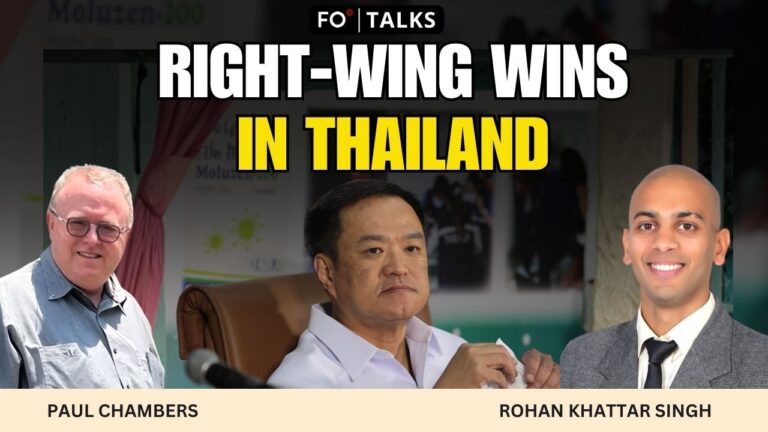
Fair Observer’s Video Producer Rohan Khattar Singh speaks with Professor Paul Chambers about Thailand’s general election, held February 8, 2026. It delivered a decisive victory for conservative forces led by Thai Prime Minister Anutin Charnvirakul and his Bhumjaithai Party. The result now reshapes the country’s political landscape, as nationalism, rural mobilization and institutional power outweigh strong urban support for the progressive People’s Party. Thailand now stands at a crossroads, where demands for democratic reform collide with entrenched elite authority.

Nationalism, strategy and electoral muscle

Chambers describes the vote as “a landslide victory for the forces of the right,” marking a sharp setback for progressive reformists. Early polling had favored the social democratic People’s Party, successor to the dissolved Move Forward and Future Forward parties. Yet a convergence of political forces shifts the outcome.

A border clash between Thailand and Cambodia in July 2025, which resulted in Thai casualties, fuels nationalist sentiment. A leaked phone call between then-Prime Minister Paetongtarn Shinawatra and former Cambodian strongman Hun Sen, in which she spoke negatively about the Thai army, further intensifies public anger. Chambers argues that Anutin capitalized on the moment and used “nationalism to glide towards a victory.”

But nationalism alone does not explain the result. Chambers points to allegations of vote buying in several provinces, coordination among conservative parties to avoid splitting the vote and the strategic use of local power brokers. Bhumjaithai also benefits from access to bureaucratic networks while in office, helping channel resources through provincial structures. Legal and questionable tactics combine to produce a commanding win.

Urban–rural divide, not an ideological earthquake

The election reveals a stark geographic split. The People’s Party wins every district in Thailand’s capital of Bangkok and nearly all seats in the northern city of Chiang Mai. Rural provinces, particularly those near the Cambodian border, tilt heavily toward Anutin.

This pattern seems to reflect structural differences rather than a sweeping ideological realignment. Urban voters gravitate toward progressive platforms, while rural constituencies respond more strongly to nationalism and patronage networks. Chambers does not see the result as evidence of a permanent conservative turn, however. Instead, he calls it the “temper of the times,” shaped by border tensions and political mood.

He also criticizes the People’s Party’s internal weaknesses. Compared to its predecessors, it fails to organize effectively at the grassroots level and struggles to resonate beyond urban centers. The loss, then, stems not only from repression or manipulation but from strategic shortcomings within the reform movement itself.

Monarchy, military and managed democracy

The structure of Thai power serves as a major talking point. Chambers explains that King Rama X, the king of Thailand, stands above politics and democracy. He says Thailand operates through a partnership between the monarchy and the military, with the armed forces acting as guardian and junior partner.

The Senate, appointed rather than elected under the 2017 constitution, plays a decisive role in selecting the prime minister alongside the lower house. Parliament functions, but within strict boundaries. The lower chamber can debate budgets and investigate issues, yet it operates under the shadow of potential military intervention. Any serious challenge to royal prerogatives risks triggering a coup.

This framework shapes electoral politics. Even when progressive parties perform well, institutional levers remain firmly in conservative hands. Courts, oversight bodies and security forces collectively reinforce elite dominance.

Section 112 and the cost of dissent

The discussion turns personal when Chambers recounts his own prosecution under Section 112 of Thailand’s criminal code, the lèse-majesté law. The statute prohibits insulting the monarchy and carries severe penalties. He describes it as “a very ambiguous law,” one that allows broad interpretation and political weaponization.

In April 2025, Chambers was sentenced to 15 years in prison over a conference flyer stating that the king holds more power than the prime minister. Although he did not write or post the material, his name appears in connection with the event. He spent two nights in a rural prison before being released on bail. Charges were eventually dropped by the attorney general, but immigration authorities retained his passport until he boarded a flight out of Bangkok. “Yes, I had to flee,” he tells Khattar Singh.

His case is not isolated. More than 280 individuals face Section 112-related cases. Anti-monarchy protests between 2020 and 2023 drew thousands of young demonstrators. The state responds not only with arrests but with subtler tactics: visits to families, legal pressure and selective prosecutions. Prominent activist Arnon Nampa remains imprisoned. Such measures weaken the reform movement incrementally rather than through dramatic mass repression.

Constitutional reform at a crossroads

Alongside the election, voters support a referendum to begin drafting a new constitution to replace the military-backed 2017 charter. Reformers hope to curtail the appointed Senate’s power and restore a more democratic framework akin to the 1997 constitution.

Yet the path forward is steep. Three separate referendums are required to amend the charter. Chambers doubts the new government will push aggressively for further votes. With a fresh electoral mandate, Anutin can argue that voters have rejected sweeping change.

Meanwhile, judicial pressure intensifies. The National Anti-Corruption Commission forwards a case against 44 People’s Party members to the Supreme Court. If upheld, the ruling could strip them of political rights and potentially dissolve the party altogether. Chambers sees this as part of a broader strategy to erode progressive reformism bit by bit.

Thailand’s election thus reflects more than a partisan shift. It exposes the tension between popular demands for democratic change and a resilient alliance of monarchy, military and judiciary. Whether reformers can overcome institutional barriers or whether conservative dominance hardens further will shape the country’s political future and reverberate across Southeast Asia.

[Lee Thompson-Kolar edited this piece.]

The views expressed in this article/video are the author’s own and do not necessarily reflect Fair Observer’s editorial policy.


post-content-short=”
Fair Observer’s Video Producer Rohan Khattar Singh speaks with Professor Paul Chambers about Thailand’s general election, held February 8, 2026. It delivered a decisive victory for conservative forces led by Thai Prime Minister Anutin Charnvirakul and his Bhumjaithai Party. The result now…”
post_summery=”In this episode of FO Talks, Rohan Khattar Singh and Paul Chambers discuss Thailand’s 2026 general election, which reelected conservative Prime Minister Anutin Charnvirakul amid rising nationalism. Despite urban support for the People’s Party, rural mobilization and institutional advantages favor the right. They also explore the monarchy–military alliance, Section 112 prosecutions and the uncertain path of constitutional reform.”
post-date=”Apr 17, 2026″
post-title=”FO Talks: How Nationalism, the Monarchy and Cambodia Shaped Thailand’s 2026 Election” slug-data=”fo-talks-how-nationalism-the-monarchy-and-cambodia-shaped-thailands-2026-election”>

FO Talks: How Nationalism, the Monarchy and Cambodia Shaped Thailand’s 2026 Election


Hugh Dugan”
post_date=”April 17, 2026 06:22″
pUrl=”https://www.fairobserver.com/world-news/fo-live-wars-rage-in-iran-and-ukraine-where-is-the-united-nations/” pid=”161937″
post-content=”

Fair Observer’s Video Producer Rohan Khattar Singh speaks with Hugh Dugan, a former UN insider and president of Multilateral Accountability Associates, and Daniel Wagner, the organization’s managing director and a political risk expert, about whether multilateralism can still function in a world shaped by war, rivalry and institutional fatigue. Global problems are increasingly interconnected, yet the institutions meant to manage them appear weaker, slower and less credible. Rather than declaring the system dead, Dugan and Wagner argue that multilateralism is changing form. The challenge now is to make it more accountable, more flexible and more relevant.

A fractured order without a clear replacement

Khattar Singh begins by asking whether today’s world is the most fractured it has ever been. Dugan resists that conclusion. He says the current moment feels unusually heavy because crises move faster, news travels instantly and everyone can now consume and comment on world events in real time. Even so, he cautions against assuming that the present is uniquely catastrophic.

Dugan points to one paradox in the current order. While internal conflicts remain widespread, wars between states are relatively rare by historical standards. He also argues that countries are now more likely than before to see distant crises as shared concerns rather than someone else’s problem.

Wagner takes a more skeptical stance. The real difficulty lies in the absence of an agreed successor to the liberal order that followed the Cold War. In his view, power has become too diffuse for any stable framework to hold. He describes this condition as “diffuse multipolarity,” which he says is “collapsing our normative architecture.” For him, the problem is not simply that the world is changing, but that no accepted structure has emerged to manage that change.

From old multilateralism to a more crowded system

The discussion then turns to what Wagner and Dugan call the “new multilateralism.” Dugan defines the old model as a system dominated by governments and intergovernmental bodies, where civil society, academics and ordinary citizens remain outside the room. That structure, he suggests, no longer reflects how influence actually works.

In its place, Dugan sees a more crowded environment. Social media, digital communication, corporations and wealthy private actors now shape global affairs alongside states. Issue-based networks can form quickly, operate across borders and exert real pressure on governments and institutions. He believes multilateralism is no longer just about formal diplomacy among states — it is also about how these newer actors enter spaces once reserved for governments alone.

This is one reason he believes institutions like the United Nations have struggled to keep pace. They still operate through older structures even as the world around them has changed. Dugan says that many of these bodies have become too bureaucratic and too inward-looking. In his telling, they have focused more on preserving themselves than on adapting to new realities.

Accountability, outcomes and the limits of reform

A central theme of the conversation is accountability. Dugan argues that international institutions have long measured the wrong things. Too often, they highlight outputs such as meetings, reports or programs rather than outcomes that show whether real progress has been made. For him, that distinction is critical. The question is not how active an institution appears, but whether it actually solves problems.

Wagner agrees and states that many countries have already responded to institutional weakness by shifting toward bilateral arrangements. They still need trade, security and cooperation, but they no longer trust the multilateral system to deliver. His preferred answer is not to abolish existing institutions, but to supplement them with more flexible coalitions built around specific issues.

He also sees a role for new tools. Wagner believes that digital governance, including blockchain and AI, could improve transparency and strengthen accountability across institutions that now rely too heavily on slow and opaque processes. Simultaneously, he doubts that major international bodies will change on their own. These organizations, he suggests, are too entrenched for wholesale reform unless governments and outside actors apply sustained pressure.

The UN Security Council and the problem of power

Wagner and Dugan disagree strongly about the UN Security Council. Wagner feels the current structure no longer reflects our modern world. He points to the five permanent members as a relic of World War II and says countries such as India remain unjustifiably excluded from the top table. He considers the arrangement outdated and increasingly hard to defend.

Dugan takes a different stance: that the Security Council still performs its core function because it forces the most dangerous powers to remain engaged with one another. “It works and it works well,” he says, not because it is democratic, but because it keeps major powers in the same room. Dugan finds the veto frustrating but useful. It gives powerful states an incentive to stay inside the system rather than act wholly outside it.

He is also doubtful that formal reform will happen soon. Instead of expanding the permanent membership, he proposes a more modest change: elected members should act as true representatives of their regions rather than merely advancing their own national interests. That would not solve the legitimacy problem, but it could make the Council more representative in practice.

Norms, middle powers and the future of the UN

Khattar Singh presses both guests on whether international rules now apply mainly to weaker states while great powers ignore them when convenient. Wagner largely agrees, though he feels that reputational costs still matter at the margins. Dugan answers with more optimism. He says the UN’s greatest achievement may not be enforcement, but the accumulation of norms that define acceptable conduct. From human rights to humanitarian principles, these standards still shape expectations even when they are violated.

The discussion ends by considering middle powers and the United States. Wagner sees countries such as India, Canada and Australia as increasingly important bridge-builders in a world where many states do not want to align fully with either Washington or Beijing. Dugan makes a similar point in more institutional terms: smaller and mid-sized states often value multilateral platforms more than great powers do because they need them more.

On the US, both reject the idea that Washington is simply abandoning multilateralism. Wagner sees recent funding cuts as a way of pressuring institutions to change. Dugan frames the Trump approach in more transactional terms, arguing that the UN is being treated like an underperforming property that powerful actors still believe could yield value if restructured.

The crisis of multilateralism is real, but it does not mean global cooperation is over. It means the old system no longer fits the world it claims to govern.

[Lee Thompson-Kolar edited this piece.]

The views expressed in this article/video are the author’s own and do not necessarily reflect Fair Observer’s editorial policy.


post-content-short=”
Fair Observer’s Video Producer Rohan Khattar Singh speaks with Hugh Dugan, a former UN insider and president of Multilateral Accountability Associates, and Daniel Wagner, the organization’s managing director and a political risk expert, about whether multilateralism can still function in a…”
post_summery=”In this episode of FO Live, Rohan Khattar Singh, Hugh Dugan and Daniel Wagner examine whether multilateralism is failing or evolving in a fragmented global order. While institutions like the United Nations struggle with relevance, accountability and outdated structures, new actors are reshaping global governance. The future of multilateralism depends on adapting institutions to deliver outcomes, not just process.”
post-date=”Apr 17, 2026″
post-title=”FO Live: Wars Rage in Iran and Ukraine, Where is the United Nations?” slug-data=”fo-live-wars-rage-in-iran-and-ukraine-where-is-the-united-nations”>

FO Live: Wars Rage in Iran and Ukraine, Where is the United Nations?


Bryn Barnard”
post_date=”April 14, 2026 05:48″
pUrl=”https://www.fairobserver.com/business/technology/fo-talks-from-minneapolis-to-kuwait-welfare-model-under-pressure-in-the-ai-era/” pid=”161879″
post-content=”

Editor-in-Chief Atul Singh and author Bryn Barnard discuss whether universal basic income can really solve the social dislocation promised by artificial intelligence. Their conversation moves far beyond abstract theory. Using Kuwait as a real-world example of a society sustained by oil wealth, Barnard argues that the country already offers something close to a universal basic income (UBI) system. In doing so, it reveals the political, economic and moral complications that come with paying citizens while relying on others to do much of the work.

AI, redundancy and the UBI question

The discussion begins with the larger technological fear driving renewed interest in UBI. Singh asks Barnard to assess predictions that AI could replace both cognitive and manual labor, leaving millions economically unnecessary. Barnard notes that some thinkers, including Yuval Noah Harari, imagine AI not merely as a tool but as an autonomous force that may eventually outperform humans across most forms of work.

Barnard highlights the critics. He points to figures such as cognitive scientist Gary Marcus and author Ed Zitron, who argue that current large language models remain deeply flawed, whether because of hallucinations, financial unsustainability or the poor quality of synthetic training data. Even so, the uncertainty does not remove the policy problem. If AI does eliminate vast numbers of jobs, governments will still have to decide how displaced populations are meant to live.

That is where UBI reenters the debate. Rather than treating it as a futuristic abstraction, Barnard turns to a country that already approximates it in practice.

Kuwait as a living model

Barnard presents Kuwait as an oil-funded welfare state where citizens receive extensive benefits that together amount to a substantial annual social transfer. As he explains, “It’s about [$33,000] to $60,000 a year, depending on how you do your counting.” Free healthcare, free education, subsidized housing, child-related benefits and guaranteed public-sector jobs combine to create a system in which many citizens enjoy economic security without participating fully in a competitive labor market.

This model rests on a sharp hierarchy. Kuwait has roughly 1.5 million citizens, alongside a far larger population of migrant workers who carry out much of the country’s manual and professional labor. Barnard explains that this arrangement emerged when Kuwait lacked the domestic skills needed to build a modern state. Migrants became teachers, engineers, administrators and laborers, while the state used oil wealth to distribute benefits to citizens.

For Barnard, Kuwait shows what can happen when income is detached from productive pressure over generations. A large share of citizens work in protected government positions, where advancement is often weakly tied to performance or innovation. This, he argues, creates long-term deskilling.

Migrant labor and the human cost

The conversation then turns to the structure that makes this system function. Singh presses Barnard on the treatment of migrants across the Gulf. Barnard describes the Kafala system, under which workers’ legal status is tied to employers who may hold their passports and control their mobility. He agrees with Singh that this resembles bonded labor, even if the comparison is not exact.

Barnard also recounts the cruelty that can emerge when a society views migrant labor as disposable. During Covid-19, a Kuwaiti influencer suggested that migrants be sent into the desert to die so they would not spread disease. Unfortunately, a wider dehumanization is built into the system.

Kuwait’s dependence on migrants, then, is not just an economic fact. It is a moral contradiction within a welfare order that protects one population by exposing another to precarity and abuse.

Citizenship, denaturalization and shrinking the welfare pool

Barnard argues that Kuwait’s real warning for UBI advocates lies not only in deskilling, but in what happens when the money tightens. As oil revenues fluctuate and long-term fiscal pressures mount, the state has looked for ways to reduce the number of people entitled to benefits. That has taken the form of citizenship revocation.

Barnard describes how thousands have been denaturalized, including dual nationals and others whose family claims have come under state scrutiny. “The campaign is not over,” he warns, underscoring that citizenship itself is becoming a fiscal instrument. In effect, reducing the citizen pool becomes a way of reducing obligations.

This is where the conversation becomes especially relevant beyond Kuwait. Singh draws comparisons to debates in the United States over immigration, denaturalization and welfare burdens. Barnard suggests that once a state promises cradle-to-grave security, political pressure may grow to decide who fully belongs and who does not.

The deeper problem of meaning

By the end of the discussion, Barnard argues that Kuwait exposes more than a budgetary problem. It reveals a human one. “Kuwaitis have been deskilled,” he says. In Kuwaiti society, guaranteed support can weaken incentives to build capability, purpose and resilience.

That insight gives the conversation its wider force. UBI may cushion economic disruption, but Kuwait suggests that it can also generate dependency, distort citizenship and leave unresolved the question Singh repeatedly returns to: If work disappears, what gives life structure and meaning? Barnard’s answer is not that welfare should be abolished, but that any society considering UBI must reckon with its unintended consequences before treating it as a simple solution to the age of AI.

[Lee Thompson-Kolar edited this piece.]

The views expressed in this article/video are the author’s own and do not necessarily reflect Fair Observer’s editorial policy.


post-content-short=”
Editor-in-Chief Atul Singh and author Bryn Barnard discuss whether universal basic income can really solve the social dislocation promised by artificial intelligence. Their conversation moves far beyond abstract theory. Using Kuwait as a real-world example of a society sustained by oil wealth,…”
post_summery=”In this episode of FO Talks, Atul Singh and Bryn Barnard consider Kuwait as a test case for universal basic income in an age of AI-driven job loss. Kuwait’s welfare state shows how generous benefits can create deskilling, dependence on migrant labor and rising pressure to narrow citizenship when fiscal strains grow. UBI can bring deep political and social consequences.”
post-date=”Apr 14, 2026″
post-title=”FO Talks: From Minneapolis to Kuwait — Welfare Model Under Pressure in the AI Era” slug-data=”fo-talks-from-minneapolis-to-kuwait-welfare-model-under-pressure-in-the-ai-era”>

FO Talks: From Minneapolis to Kuwait — Welfare Model Under Pressure in the AI Era


Vinay Singh”
post_date=”April 13, 2026 05:47″
pUrl=”https://www.fairobserver.com/business/fo-talks-the-9-trillion-crisis-ai-burnout-and-the-collapse-of-white-collar-jobs/” pid=”161853″
post-content=”

Fair Observer’s Chief Strategy Officer Peter Isackson and Global Civilization Dynamics Founder Vinay Singh to examine a silent breakdown in the modern white-collar economy. They begin with a striking anecdote: a software engineer claiming experience at Meta sends hundreds of applications and reaches out to more than a thousand recruiters without receiving a single offer. For Singh, the episode raises a disturbing possibility about today’s labor market. “When this top-tier engineer sends 1,000 signals into the market and gets back nothing but silence,” he says, “we have to ask: Is the hiring system broken or is it working exactly as designed?”

Their discussion widens from this example to a broader diagnosis of technological change, economic transformation and mounting worker burnout. Both speakers argue that artificial intelligence, financialized markets and decades of economic restructuring may be redefining the value of human labor itself.

The “black hole” of hiring

Singh frames the engineer’s experience as evidence of what he calls the “black hole of human meritocracy.” Highly qualified candidates increasingly encounter opaque hiring systems dominated by automated screening tools. Resumes disappear into applicant-tracking systems, while recruiters struggle to distinguish genuine candidates from automated applications generated by AI tools.

The phenomenon, Singh suggests, echoes earlier labor shocks. He points to similarities with the aftermath of the 2008 financial crisis, when job seekers reported submitting hundreds of applications with little response. The difference today is the scale and persistence of the problem, which now spans multiple economic cycles.

The result may be a profound misallocation of human effort. Millions of workers spend vast amounts of time tailoring resumes and applications that are processed almost entirely by algorithms. Singh characterizes this as a massive extraction of human productivity from the economy without producing meaningful output.

From postwar inclusion to financialized capitalism

Isackson situates the present moment within a longer historical arc. In the decades following World War II, Western economies cultivated a strong sense of social participation. Programs such as the US GI Bill and New Deal institutions created relatively stable employment and reinforced the idea that society needed the contributions of ordinary citizens.

That sense of belonging, he argues, gradually eroded over the past half-century. Economic thinking increasingly prioritized shareholder returns and financial markets over employment and social stability. This has resulted in a system that measures value almost exclusively through financial outcomes.

“We’ve seen a long trend going in the direction of devaluing human presence,” he says. Human worth, once embedded in institutions and communities, is now assessed primarily through economic productivity.

The rise of agentic AI

They then turn to the accelerating development of artificial intelligence. Singh distinguishes between the generative AI that became widely visible in recent years and a newer phase known as agentic AI — systems capable of performing complex tasks autonomously.

Recent partnerships between technology companies and research organizations illustrate the shift. AI systems are now being deployed to analyze biological data, design pharmaceutical compounds and carry out tasks that once required large teams of human specialists.

Singh describes a rapidly emerging “bot-versus-bot” economy in which automated systems apply for jobs while other algorithms evaluate applications. “Human beings’ souls are being lost,” he warns, arguing that the decoupling of labor from value creation threatens the foundations of the modern workforce.

Isackson agrees that the economic logic driving automation is powerful. Yet he stresses that production alone cannot define human activity within an economy. Businesses and institutions, he argues, are not merely technical systems but social environments shaped by human interpretation and meaning.

Burnout in the global workforce

Evidence is mounting of global worker burnout. Singh cites workforce surveys reporting that more than 80% of employees experience some level of exhaustion or disengagement. Younger workers appear particularly affected, with high levels of reported stress and declining engagement.

The phenomenon extends beyond white-collar sectors. Labor unrest across Europe, including widespread strikes in Italy’s transportation sector, reflects similar frustrations among blue-collar workers facing stagnant wages and rising costs of living.

Isackson believes burnout reflects more than excessive workloads. Many workers are experiencing a deeper loss of purpose within economic systems that no longer recognize their broader human value. When individuals feel interchangeable or invisible within automated systems, they can experience severe psychological consequences.

A civilizational turning point

Singh points to the growing recognition among global economic leaders that technological change may be reshaping capitalism itself. Some figures within finance and industry have warned that AI-driven productivity gains could deepen inequality and destabilize consumer economies.

Isackson sees these concerns as signs of a larger historical transition. The transformation now underway may force societies to rethink the relationship between technology, labor and human identity.

“We’re in a great transformation,” he says. Whether political and business leaders can adapt to that transformation remains uncertain. Yet both speakers agree that the scale of the changes now unfolding suggests that the future of work, and perhaps the meaning of human contribution within modern economies, is entering a decisive new phase.

[Lee Thompson-Kolar edited this piece.]

The views expressed in this article/video are the author’s own and do not necessarily reflect Fair Observer’s editorial policy.


post-content-short=”
Fair Observer’s Chief Strategy Officer Peter Isackson and Global Civilization Dynamics Founder Vinay Singh to examine a silent breakdown in the modern white-collar economy. They begin with a striking anecdote: a software engineer claiming experience at Meta sends hundreds of applications and…”
post_summery=”In this episode of FO Talks, Peter Isackson and Vinay Singh examine a growing crisis in white-collar employment as automation, opaque hiring systems and financialized capitalism reshape the labor market. Agentic AI and algorithmic hiring may be decoupling human work from economic value. The discussion frames rising burnout and disengagement as signs of a deeper civilizational transition.”
post-date=”Apr 13, 2026″
post-title=”FO Talks: The $9 Trillion Crisis — AI, Burnout and the Collapse of White Collar Jobs” slug-data=”fo-talks-the-9-trillion-crisis-ai-burnout-and-the-collapse-of-white-collar-jobs”>

FO Talks: The $9 Trillion Crisis — AI, Burnout and the Collapse of White Collar Jobs


Kanwal Sibal”
post_date=”April 12, 2026 05:56″
pUrl=”https://www.fairobserver.com/world-news/fo-live-kanwal-sibal-explains-why-india-is-europes-strategic-alternative-to-china/” pid=”161831″
post-content=”

Fair Observer’s Chief Strategy Officer Peter Isackson, former Foreign Secretary of India Kanwal Sibal and Assistant Editor Luna Rovira discuss the landmark January 27 trade agreement between India and the European Union. Sibal frames it in striking terms, calling it the “mother of all deals” because of the scale involved: India’s 1.4 billion-strong market linking with the EU’s 27-nation bloc, whose economy rivals that of the United States.

India is already the world’s fourth-largest economy and is projected to become the third within a few years. Europe, meanwhile, remains a high-consumption, technologically advanced export power but faces demographic decline and slow growth. Sibal sees the agreement as more than commercial; once economic linkages deepen, political cooperation on international issues becomes easier. Trade, investment and technology transfer create strategic ballast.

The deal also reflects Europe’s recalibration away from China. Sibal argues that Beijing’s “excessive manufacturing capacities” and dominance in rare earths, renewables and key industrial processes have generated structural imbalances. Europe seeks resilient supply chains and alternatives to overdependence. In this context, he describes India as “a very attractive partner,” citing democratic governance, market openness and greater predictability compared to China.

Trump, tariffs and strategic diversification

US President Donald Trump serves as the catalyst here. The US imposed 15% tariffs on Europe while extracting major energy purchase and investment commitments. This has shaken European confidence in the transatlantic relationship.

Sibal argues that Trump has “humiliated Europe,” not only through trade pressure but through the broader disruption of NATO structures and Ukraine diplomacy. Isackson probes whether Europe’s long-standing subordinate alignment with Washington has reached a breaking point. Sibal identifies that India and Europe now seek to “expand [their] options” and reduce exposure to American unpredictability.

For India, the calculus is similar. It faces some of the highest US tariffs, and the future direction of American trade policy remains uncertain. The India–EU agreement thus reflects mutual hedging. It is an attempt to widen strategic autonomy in an era of volatile American leadership.

Europe, Ukraine and the question of sovereignty

The discussion broadens to Europe’s geopolitical standing, especially in the Ukraine war. Sibal observes that both Trump and Russian President Vladimir Putin have sidelined Europe in negotiations. For him, this exclusion signals that Washington does not assign Europe decisive weight in matters of continental security.

He also argues that Europe weakened its own credibility. Admissions by former French President François Hollande and former German Chancellor Angela Merkel that the Minsk agreements served as temporary arrangements undermined trust in Moscow. Meanwhile, Baltic states and Poland exert disproportionate influence within EU consensus politics, amplifying a moralized anti-Russian narrative.

Isackson raises the internal fragmentation of Europe itself: weak parliamentary authority at the EU level, rising populist parties such as Germany’s Alternative for Germany, and declining public trust in national governments. Sibal agrees that the Belgian capital of Brussels has accumulated authority in areas that blur the boundaries of member-state sovereignty, though he cautions against dismissing Europe as strategically irrelevant. If Washington and Brussels coordinate effectively, Europe could still shape outcomes. But at present, he sees a continent struggling to define a coherent geopolitical voice.

Regulation, reform and economic complementarity

On the mechanics of the deal, Sibal pushes back against concerns about India’s bureaucratic readiness. He believes Europe’s regulatory ecosystem poses a greater challenge. The EU’s strict health, digital and environmental standards — including the Carbon Border Adjustment Mechanism — may limit practical market access even after tariff reductions.

Agriculture, notably contentious in the agreement between the EU and the Southern Common Market trade bloc, is excluded from the India deal, reducing the likelihood of domestic backlash. The deal also includes a mobility framework for skilled workers, which Sibal distinguishes from immigration.

He stresses economic complementarity. Indian exports in textiles, leather, gems and jewelry could benefit significantly as duties fall to zero. Europe supplies advanced industrial goods and technology. India, meanwhile, is consciously reducing protectionism, having concluded or pursued agreements with Australia, the United Arab Emirates, the United Kingdom and others. Integration into global supply chains is now a strategic priority, not an afterthought.

Russia, sanctions and India’s strategic balance

The final segment addresses India’s continued purchase of Russian oil and its role within BRICS. Sibal insists India has violated no international law. Purchases were made at discounted price caps set by the US, and Indian refiners operated within sanction parameters. Recent US tariff penalties have already reduced Indian offtake.

European leaders have voiced concern, and some Indian firms have faced EU sanctions. Still, Sibal rejects accusations of hypocrisy as “ridiculous,” especially given Europe’s own substantial energy purchases from Russia in the early years of the war.

India, he emphasizes, will not sever ties with Moscow or its BRICS partners. Rather, it is a moderating force within BRICS — a country that prevents the grouping from hardening into a purely anti-Western bloc. In his formulation, India’s presence serves Western interests by keeping channels open between democratic and authoritarian systems. A multipolar world, in his view, should not be anti-Western but more balanced, giving emerging powers a greater voice in global governance.

[Lee Thompson-Kolar edited this piece.]

The views expressed in this article/video are the author’s own and do not necessarily reflect Fair Observer’s editorial policy.


post-content-short=”
Fair Observer’s Chief Strategy Officer Peter Isackson, former Foreign Secretary of India Kanwal Sibal and Assistant Editor Luna Rovira discuss the landmark January 27 trade agreement between India and the European Union. Sibal frames it in striking terms, calling it the “mother of all deals”…”
post_summery=”In this episode of FO Talks, Peter Isackson, Luna Rovira and Kanwal Sibal discuss the January 27 India–EU trade agreement. They argue that US unpredictability, alongside Europe’s frictions with China and its Ukraine-era strategic confusion, helped accelerate Europe’s turn toward India. The conversation examines regulatory hurdles, economic complementarity and India’s positioning as a balancing power in a multipolar order.”
post-date=”Apr 12, 2026″
post-title=”FO Live: Kanwal Sibal Explains Why India Is Europe’s Strategic Alternative to China” slug-data=”fo-live-kanwal-sibal-explains-why-india-is-europes-strategic-alternative-to-china”>

FO Live: Kanwal Sibal Explains Why India Is Europe’s Strategic Alternative to China


Ben Freeman”
post_date=”April 11, 2026 05:20″
pUrl=”https://www.fairobserver.com/world-news/fo-talks-is-america-building-a-1-5-trillion-war-machine-to-fight-china/” pid=”161815″
post-content=”

Editor-in-Chief Atul Singh and Ben Freeman, co-author of The Trillion Dollar War Machine: How Runaway Military Spending Drives America into Foreign Wars and Bankrupts Us at Home, discuss US President Donald Trump’s proposed $1.5 trillion defense budget. Their conversation moves beyond headline numbers to examine threat inflation, the power of defense contractors and the mounting risks posed by America’s nearly $39 trillion national debt. At stake is military posture toward China and the long-term sustainability of the American state.

The 1.5 trillion-dollar question

Singh opens by noting that Trump has called for a $1.5 trillion military budget for fiscal year 2027, a figure endorsed by The Washington Post’s editorial board. Supporters argue that as a percentage of GDP, defense spending is historically low, and that China’s rapid military buildup demands urgent investment.

“I don’t think much of it,” Freeman says bluntly. He points out that the current US military budget is already roughly three times larger than China’s. The United States maintains more than 700 overseas bases, effectively surrounding China, while Beijing operates only a handful abroad. Ignoring that accumulated infrastructure distorts the debate.

When Singh raises concerns about China’s 22 shipyards, drone production and expanding industrial capacity, Freeman stresses the difference between quantity and quality. “The Chinese Navy pales in comparison to the US Navy,” he states, insisting that technological sophistication and global reach matter more than raw output. For him, tripling China’s spending has already secured a qualitative advantage. Raising it to five times China’s level requires a clearer strategic rationale than simply invoking Beijing’s rise.

Threat inflation and the iron triangle

The conversation then turns to “threat inflation,” a concept central to Freeman’s work. The military-industrial complex requires a persistent adversary to justify its scale. Without an external foe, Americans might begin asking why resources are not directed toward healthcare, education or infrastructure.

Freeman describes the “iron triangle” linking Congress, the Pentagon and defense contractors. Roughly 54% of the Department of Defense budget flows to private contractors, including Lockheed Martin, Raytheon, Boeing, Northrop Grumman and General Dynamics. These firms then invest heavily in lobbying, campaign contributions and hiring former officials, reinforcing a cycle that sustains high spending.

The result, he says, is a self-perpetuating system that has expanded beyond what President Dwight Eisenhower warned about in 1961. Today, the ecosystem includes think tanks, universities, media organizations and even local institutions, all reinforcing the normalization of American militarism.

The defense tech disruption

Yet the system is not static. Singh asks whether the “Big Five” will simply continue vacuuming up taxpayer money indefinitely. Freeman points to the rise of defense tech firms such as SpaceX, Anduril and Palantir as a disruptive force.

These companies, often backed by Silicon Valley capital and closely connected to the Trump administration, are competing with legacy contractors for Pentagon contracts. Freeman characterizes the moment as a pivotal transition, with tech-driven firms potentially supplanting parts of the old guard.

But he tempers expectations. “A rising tide is lifting all defense contractors right now,” he notes. Even if the composition of contractors changes, the overall budget trajectory shows little sign of decline.

Debt, deficits and the limits of expansion

The most sobering portion of the discussion concerns the national debt. With US debt nearing $39 trillion and annual deficits exceeding $1 trillion, Freeman warns that any increase in defense spending will be entirely debt financed. According to projections, a $1.5 trillion annual budget could add nearly $6 trillion to the debt over a decade.

For the first time, US debt servicing costs now exceed the Pentagon budget. Interest payments alone are approaching $1 trillion annually. Freeman cautions that borrowing to pay interest risks triggering a vicious debt spiral. The US has not run a budget surplus since 1999, making this a bipartisan problem decades in the making.

If defense spending remains politically sacrosanct and debt servicing unavoidable, the remaining pressure points are the long-untouchable Social Security, Medicare and Medicaid. Cutting them, Freeman observes, would be “political suicide.” That leaves Washington with few painless options.

A new cold war?

As the US–Russia New START treaty expires and nuclear arms control weakens, Singh raises the prospect of an accelerating arms race. Freeman questions the strategic logic of expanding nuclear arsenals beyond already overwhelming levels, arguing that such expansions chiefly benefit contractors.

Still, he concedes that a technological cold war with China is real. Competition in artificial intelligence, robotics, drones and hypersonics is intensifying. Here, Freeman does not oppose investment per se. Instead, he criticizes what he sees as misallocation. The problem, he suggests, is not insufficient funding but inefficient spending on legacy platforms at the expense of emerging technologies.

Ultimately, the debate is about how the US will prepare to face Chinese competition. Singh and Freeman leave viewers with a dilemma: expand the war machine and risk fiscal crisis, or reform it before the debt itself becomes the greatest national security threat of all.

[Lee Thompson-Kolar edited this piece.]

The views expressed in this article/video are the author’s own and do not necessarily reflect Fair Observer’s editorial policy.


post-content-short=”
Editor-in-Chief Atul Singh and Ben Freeman, co-author of The Trillion Dollar War Machine: How Runaway Military Spending Drives America into Foreign Wars and Bankrupts Us at Home, discuss US President Donald Trump’s proposed $1.5 trillion defense budget. Their conversation moves beyond headline…”
post_summery=”In this episode of FO Talks, Atul Singh and Ben Freeman examine US President Donald Trump’s proposed $1.5 trillion defense budget, questioning whether China’s rise justifies such expansion. Freeman critiques threat inflation, the entrenched “iron triangle” and growing influence of defense contractors. He warns that rising debt and interest payments may pose a greater long-term threat than Beijing.”
post-date=”Apr 11, 2026″
post-title=”FO Talks: Is America Building a $1.5 Trillion War Machine to Fight China?” slug-data=”fo-talks-is-america-building-a-1-5-trillion-war-machine-to-fight-china”>

FO Talks: Is America Building a $1.5 Trillion War Machine to Fight China?


Kuber Chalise”
post_date=”April 10, 2026 05:35″
pUrl=”https://www.fairobserver.com/politics/fo-talks-nepals-political-earthquake-as-gen-z-elevates-a-rapper-to-power/” pid=”161799″
post-content=”

[Editor’s note: This interview was conducted on March 13, prior to Nepali Prime Minister Balen Shah’s inauguration on March 27, 2026.]

Rohan Khattar Singh, Fair Observer’s Video Producer & Social Media Manager, speaks with Kuber Chalise, a journalist for Nepal Khabar, about the election that has upended Nepal’s political order. At the center of the discussion is the rise of Balen Shah, a 35-year-old engineer, former rapper and former mayor of Kathmandu, who has become prime minister after the Rashtriya Swatantra Party’s sweeping victory. Khattar Singh and Chalise explore why traditional parties collapsed so quickly, why young voters turned so sharply against the old guard and why Nepal’s new leaders now face a harder test in government than they did at the ballot box.

A revolt against the old parties

Chalise presents the result as a long time coming. Nepal’s established parties, including the Nepali Congress and major communist factions, lost public trust over years of corruption, nepotism and poor governance. These parties had once expanded rights and shaped the post-monarchy political system, but they failed to adapt after the 2015 constitution.

That failure created a widening gap between political elites and the public, especially younger voters. Chalise says the old parties behaved as though politics could continue as usual even after their original mission had ended. Public frustration deepened over stagnant leadership, weak performance and a closed political class dominated by insiders.

Khattar Singh places the election in the context of the September 2025 Generation Z protests, which erupted over these frustrations and forced the resignation of then-Prime Minister KP Sharma Oli. Despite the unrest, the subsequent vote was peaceful. Chalise calls the election’s conduct “a miracle,” given the violence that preceded it.

The scale of the political shift

The results show how decisively voters turned away from the traditional order. Chalise explains that the Rashtriya Swatantra Party (RSP) dominated the lower-house contest and is expected to hold 182 of 275 seats. By contrast, the Nepali Congress fell sharply. The Communist Party of Nepal (Unified Marxist–Leninist), led by Oli, and the Communist Party of Nepal (Maoist Centre), associated with former Prime Minister Pushpa Kamal Dahal (or Prachanda), were reduced to minor roles.

For Chalise, the message is clear. The public has handed the RSP a workable majority and the chance to govern for five years, but not a mandate to rewrite the constitution. Because the party lacks upper-house representation, it cannot change the constitutional framework alone.

The result also breaks a longstanding assumption that no single party could secure a stable majority. Khattar Singh notes that Nepal has seen 32 governments in 35 years. Still, Chalise warns that a majority alone is not enough. The real question, he suggests, is majority versus maturity.

Why Shah rose so fast

The discussion then turns to Shah. His rise began with his victory as mayor of Kathmandu, which gave voters a chance to judge his performance. His reputation rests largely on contrast. In a system associated with financial scandals, Shah emerged without a personal corruption case.

That clean image becomes his main political asset. Chalise describes it as Shah’s “USP,” the unique selling point that distinguished him from many local leaders facing corruption allegations. He also notes Shah’s unusual style. Unlike many senior leaders, Shah speaks sparingly. Chalise calls him “a very mysterious character,” and Khattar Singh notes that this unpredictability can appear both as strength and weakness.

The youth dimension is equally important. Chalise argues that for decades, Nepal’s young people drove political movements but were sidelined once power was distributed. This election reflects a democratic revolt against that pattern, with younger voters choosing to take power through the ballot.

A party with power but no identity

Even after its landslide, the RSP remains politically unsettled. Chalise says the party lacks a clear ideological identity and has not yet held its first convention. Its elected members come from varied backgrounds, including democrats, leftists and some with monarchist leanings.

Its appeal rests on delivery rather than doctrine. Khattar Singh suggests that voters increasingly prioritize jobs, prosperity and competence over ideology. Chalise agrees, noting that the party’s commitment paper points toward liberal economic instincts and a role for the private sector, though he stops short of calling it ideologically defined.

That ambiguity creates risk. If the new government performs, it may dominate Nepal for years. If it fails, support could collapse quickly. From a political science perspective, Chalise says, the RSP is “not yet a party.” It must evolve while governing.

The real test starts now

The conversation concludes with the challenge ahead. Khattar Singh points to Nepal’s difficult geography, limited state capacity and dependence on India and China for trade and energy. Nepal cannot insulate itself from regional instability or global shocks.

Chalise agrees that foreign policy may prove decisive. Nepal’s next government must navigate shifting regional dynamics and domestic expectations simultaneously. Shah’s nationalist symbolism, including the “Greater Nepal” map seen in his office, adds uncertainty. Chalise returns to the same point: Shah is unpredictable, and whether that becomes an asset or liability depends on how he governs.

For now, voters have rejected the old political class and chosen youth, anti-corruption politics and the promise of delivery. But protest energy and electoral success are only the beginning. The real test starts with governing.

[Lee Thompson-Kolar edited this piece.]

The views expressed in this article/video are the author’s own and do not necessarily reflect Fair Observer’s editorial policy.


post-content-short=”Rohan Khattar Singh, Fair Observer’s Video Producer & Social Media Manager, speaks with Kuber Chalise, a journalist for Nepal Khabar, about the…”
post_summery=”In this episode of FO Talks, Rohan Khattar Singh and Kuber Chalise analyze Nepal’s 2026 election, where Gen Z protests and anti-corruption sentiment propelled Balen Shah and the Rashtriya Swatantra Party to victory. They highlight the collapse of traditional parties and the movement away from ideology toward delivery. Governance, stability and geopolitics will determine whether this political earthquake endures.”
post-date=”Apr 10, 2026″
post-title=”FO Talks: Nepal’s Political Earthquake as Gen Z Elevates a Rapper to Power” slug-data=”fo-talks-nepals-political-earthquake-as-gen-z-elevates-a-rapper-to-power”>

FO Talks: Nepal’s Political Earthquake as Gen Z Elevates a Rapper to Power


Evan Munsing”
post_date=”April 09, 2026 06:02″
pUrl=”https://www.fairobserver.com/world-news/us-news/fo-talks-america-first-to-iran-war-making-sense-of-donald-trumps-foreign-policy/” pid=”161785″
post-content=”

Editor-in-Chief Atul Singh and Evan Munsing, candidate for Colorado’s competitive 8th Congressional District, Marine Corps veteran and entrepreneur, examine the United States’s sudden entry into war with Iran under President Donald Trump. Contradictorily, a president who campaigned on avoiding foreign entanglements has launched a new conflict in the Middle East. As Singh and Munsing explore the implications, they situate the war within a broader pattern of strategic ambiguity, institutional decline and growing public distrust. The result is not just a geopolitical crisis, but a test of American democracy itself.

Shock, contradiction and shifting goals

Munsing describes a political landscape caught off guard. Across party lines, Americans are struggling to reconcile Trump’s long-standing “America First” rhetoric with a decision to initiate war. Drawing on conversations from the campaign trail, he notes that voters are not only surprised but deeply confused about the rationale behind the conflict. “I think the first thing is just shock across the political spectrum,” he observes.

The absence of clear objectives compounds that confusion. Singh presses Munsing on what the administration is trying to achieve, and the answer remains elusive. From regime change to nuclear containment to vague notions of victory, the stated goals appear to shift constantly. Munsing points to statements from the White House suggesting that Trump alone will determine when Iran has “unconditionally surrendered,” dismissing the idea as “ridiculous.” Without a stable definition of success, the war risks replicating the strategic drift seen in Afghanistan and Iraq, where the endgame remained perpetually undefined.

Miscalculation and the risk of escalation

The discussion then turns to how the conflict began. Munsing argues that Trump’s decision-making reflects a pattern of boundary-testing behavior. Early military successes, particularly a high-risk operation in Venezuela, may have created a false sense of confidence. According to this view, the administration expected a rapid, decisive outcome in Iran — perhaps even regime collapse — without fully accounting for the complexity of the region.

This miscalculation now presents a dangerous dilemma. If the US withdraws quickly, it risks signaling failure. If it escalates, it may become trapped in a prolonged and costly conflict. Singh raises the possibility of deploying ground troops, a scenario that would dramatically raise the stakes. Munsing considers such a move unlikely but politically catastrophic, arguing that it would face overwhelming public opposition and significantly increase casualties and financial costs.

The broader concern is that the administration lacks a coherent strategy. Without clear objectives or limits, the conflict could expand in unpredictable ways, drawing the US deeper into a region already defined by volatility and competing interests.

Domestic repercussions and the terrorism calculus

Beyond the battlefield, Singh and Munsing examine how the war could reshape domestic politics. Recent lone-wolf attacks in the US complicate public sentiment. While such incidents may initially push Americans toward disengagement, a confirmed state-sponsored attack linked to Iran could have the opposite effect.

Munsing explains that a direct threat to the homeland would likely trigger a “rally around the flag” response, increasing support for the war despite broader skepticism. This distinction underscores how fragile public opinion remains. Americans may oppose the conflict in principle, but their stance could shift rapidly under the pressure of perceived national danger.

Simultaneously, the lack of a clear initial justification for the war weakens the administration’s position. Without a compelling narrative, it becomes harder to sustain public support over time, especially if the conflict drags on or casualties mount.

Congress, executive power and institutional decline

Singh highlights the constitutional role of Congress in declaring war. Munsing argues that lawmakers have increasingly ceded this power to the executive branch. “It certainly feels like we’re moving to a Cesarean presidency,” he says, pointing to a long-term trend that has accelerated in recent years.

This shift reflects deeper institutional problems. Congress, once protective of its prerogatives, now appears reluctant to assert itself. Munsing criticizes a culture of performative politics in which legislators prioritize media presence over substantive lawmaking. With approval ratings hovering around 17%, public confidence in the institution has reached strikingly low levels.

The Iran war exposes these weaknesses. Despite the absence of formal authorization, Congress has struggled to respond decisively. For Munsing, this moment represents both a failure and an opportunity: a failure to uphold constitutional responsibilities, but also a chance to reassert them, if lawmakers choose to act.

Distrust, disillusionment and fragile hope

Singh and Munsing close with a broader reflection on declining trust in American institutions. From prolonged wars in Afghanistan and Iraq to economic crises and elite scandals, many citizens now see a system that operates by different rules for the powerful and the public. Some have even labeled the conflict the “Epstein war,” viewing it as a distraction from unresolved controversies involving political and economic elites.

Munsing warns that this perception could lead to two dangerous outcomes: widespread disengagement from civic life or a turn toward more extreme political solutions. Both, he suggests, would undermine the foundations of American democracy.

Yet he also identifies tentative signs of renewal. Public frustration is driving greater political engagement, from town hall participation to grassroots campaigning. On the campaign trail, he finds that a majority of voters are willing to engage seriously, even across party lines. This rising involvement, combined with pressure on elected officials, could create an opening for institutional reform.

Whether those “green shoots” take root will depend on whether political leaders respond to public demand for accountability and clarity. As Singh and Munsing make clear, the stakes extend far beyond the Iran war itself, touching on the future of American governance in an increasingly unstable world.

[Lee Thompson-Kolar edited this piece.]

The views expressed in this article/video are the author’s own and do not necessarily reflect Fair Observer’s editorial policy.


post-content-short=”
Editor-in-Chief Atul Singh and Evan Munsing, candidate for Colorado’s competitive 8th Congressional District, Marine Corps veteran and entrepreneur, examine the United States’s sudden entry into war with Iran under President Donald Trump. Contradictorily, a president who campaigned on avoiding…”
post_summery=”In this episode of FO Talks, Atul Singh and Evan Munsing discuss why US President Donald Trump waged war on Iran despite campaigning against foreign entanglements. The administration’s aims keep shifting, risking escalation and a repeat of the strategic failures seen in Afghanistan and Iraq. This conflict is part of a wider American crisis of collapsing public trust.”
post-date=”Apr 09, 2026″
post-title=”FO Talks: America First to Iran War — Making Sense of Donald Trump’s Foreign Policy” slug-data=”fo-talks-america-first-to-iran-war-making-sense-of-donald-trumps-foreign-policy”>

FO Talks: America First to Iran War — Making Sense of Donald Trump’s Foreign Policy


Devina Mehra”
post_date=”April 09, 2026 05:45″
pUrl=”https://www.fairobserver.com/economics/fo-talks-will-ai-gold-and-dedollarization-reshape-global-markets-in-2026/” pid=”161782″
post-content=”

Fair Observer’s Video Producer Rohan Khattar Singh speaks with Devina Mehra, Founder and Chairperson of First Global, about the forces shaping global markets in 2026. After a volatile 2025 marked by wars, inflation and US President Donald Trump’s disruptive economic policies, how should investors make sense of an increasingly fragmented world? Mehra’s answer is strikingly unsentimental: geopolitics matters, but markets operate on their own logic.

Markets, Trump and the limits of geopolitics

Mehra identifies Trump as the common thread running through much of the recent turbulence. In her words, he is “dismantling the old order without your knowing what comes next.” Yet she draws a clear distinction between macro-level disruption and market behavior.

Looking at 50 years of data, from the Gulf Wars to September 11 and the US invasion of Afghanistan, she argues that stock markets tend to recover from geopolitical shocks within six to 12 months. Unless a country is directly involved in conflict, markets historically “shrug it off.” The notable exception is when major commodity producers are involved, as in the Russia–Ukraine war, where energy and commodity prices experience sustained impact.

In 2025, another dynamic was at play: extreme market concentration. The so-called Magnificent Seven US tech stocks once again drove the bulk of S&P 500 gains. In 2025, roughly 43% of the index’s performance came from this narrow group, down from more than 60% in 2023 and 2024 — but still highly concentrated. Even within that group, only three or four stocks accounted for most of the gains. The average stock, Mehra cautions, has underperformed.

The AI boom and the profitability question

Much of the recent market enthusiasm centers on artificial intelligence. Mehra remains cautious. History, she argues, shows that transformative technologies do not automatically translate into investor profits.

Automobiles and aviation reshaped the 20th century but were “a graveyard of companies” from an investor’s standpoint. The early Internet era followed a similar pattern. Infrastructure firms such as Global Crossing laid undersea cables that still carry global data traffic today — yet the company itself went bankrupt.

Mehra’s concern with AI is less about its transformative potential and more about capital intensity and monetization. Massive data centers, rapidly depreciating hardware and soaring talent costs create enormous upfront investment. Meanwhile, she points to data suggesting that usage of some AI platforms fell 60–70% during school holidays. This implies that student adoption, not high-margin enterprise demand, drives a significant portion of current traffic.

Even more worrying, she notes, is financial engineering. Some large technology firms avoid placing AI-related debt directly on their balance sheets by routing it through smaller entities that build and finance infrastructure separately. The result is systemic leverage that may be underappreciated.

India’s growth versus market reality

Turning to India, Khattar Singh challenges the dominant narrative that India is rising while the West stagnates. Mehra acknowledges that India’s headline GDP growth remains among the highest globally. Yet the composition of that growth raises questions.

Manufacturing as a share of GDP has fallen to roughly 12–13.5%, near its lowest level since the 1960s. Tourism has not yet surpassed pre-pandemic levels. Foreign direct investment and foreign institutional flows have slowed, and India recently recorded a capital account deficit for the first time in two decades.

Most importantly, Mehra stresses that macroeconomic growth does not guarantee market performance. China offers a stark example: Between 2007 and 2023, Chinese GDP expanded more than sixfold, yet its equity market only recently surpassed its 2007 peak. High growth does not automatically translate into shareholder returns or sufficient job creation.

Dedollarization, crypto and the myth of safe havens

On dedollarization, Mehra has revised her earlier skepticism. While reserve currencies rarely change quickly, she believes the pace of diversification has accelerated as confidence in US institutions comes “under question.” Even so, she doubts that China’s renminbi will replace the dollar outright. Instead, she anticipates gradual diversification toward a basket of currencies — euro, Swiss franc, Japanese yen — alongside gold.

Cryptocurrencies, in her view, are legitimate assets but not true currencies. Extreme volatility makes them impractical for pricing goods or serving as stable stores of value. With drawdowns of 70–85% occurring multiple times, she recommends limited exposure — 2% to 5% of a portfolio at most.

Gold fares no better under scrutiny. Over a 50-year period, gold has been more volatile than equities. After peaking in 1980, it took 27 years to reclaim that high. Its steady rise in Indian rupee terms, she explains, reflects currency depreciation rather than intrinsic stability.

Machines, bias and the discipline of data

At First Global, Mehra has adapted to what she sees as a structural shift in markets. In the 1990s, the edge lay in privileged information. Today, regulation ensures simultaneous disclosure. The advantage now lies in analysis.

Her firm uses machine learning systems to screen more than 20,000 securities globally, examining numerous factors without human emotional bias. Machines reduce randomness and cognitive error — insights drawn in part from behavioral economist Daniel Kahneman’s work on decision-making. Yet she insists on a “human overlay” to design models and interpret outputs. Technology is a tool, not an oracle.

Mehra will not speculate on what single trend could make or break markets in 2026. “Risk is always something you didn’t see coming,” she says, recalling how The Economist failed to flag Russia–Ukraine as a major geopolitical risk just weeks before war erupted in 2022. For her, disciplined data checks matter more than bold predictions. In an age of narrative excess, humility may be the most valuable asset of all.

[Lee Thompson-Kolar edited this piece.]

The views expressed in this article/video are the author’s own and do not necessarily reflect Fair Observer’s editorial policy.


post-content-short=”
Fair Observer’s Video Producer Rohan Khattar Singh speaks with Devina Mehra, Founder and Chairperson of First Global, about the forces shaping global markets in 2026. After a volatile 2025 marked by wars, inflation and US President Donald Trump’s disruptive economic policies, how should…”
post_summery=”In this episode of FO Talks, Rohan Khattar Singh and Devina Mehra discuss why markets often detach from geopolitics, even amid Trump-era disruption and global conflict. She questions the profitability of the AI boom, highlights extreme market concentration and warns against overinterpreting India’s growth narrative. Mehra urges diversification, limited crypto exposure and disciplined, data-driven investing over seductive market stories.”
post-date=”Apr 09, 2026″
post-title=”FO Talks: Will AI, Gold and Dedollarization Reshape Global Markets in 2026?” slug-data=”fo-talks-will-ai-gold-and-dedollarization-reshape-global-markets-in-2026″>

FO Talks: Will AI, Gold and Dedollarization Reshape Global Markets in 2026?


Fernando Carvajal”
post_date=”April 08, 2026 06:58″
pUrl=”https://www.fairobserver.com/world-news/middle-east-news/fo-live-when-will-the-houthis-join-the-war-to-support-iran/” pid=”161762″
post-content=”

Fair Observer’s Video Producer Rohan Khattar Singh moderates an FO Live discussion on the US–Israel war with Iran. He is joined by Fernando Carvajal, executive director of The American Center for South Yemen Studies; Eric Jeunot, a professor at Abu Dhabi University; and Heena Lotus, a geopolitical analyst. Khattar Singh pushes the panel to assess whether Yemen’s Houthis will enter the conflict, how Iran is calibrating its proxy network and why Gulf states are working to contain escalation. What emerges is a picture of a war no longer defined by direct strikes alone, but by chokepoints, indirect leverage and long-term strategic positioning.

The Houthi dilemma

Jeunot frames the discussion around a fundamental tension shaping Houthi decision-making. The movement is strengthening itself amid fragmentation in South Yemen, using the lull to consolidate territory, recruit fighters and rebuild capacity. Yet it faces a strategic choice between ideological alignment with Iran’s “Axis of Resistance” and its own domestic priorities.

That tension is not abstract. The Houthis must decide whether to demonstrate commitment to Iran by joining the war or instead focus on expanding control toward resource-rich areas such as Marib in Yemen. Jeunot states, “The Houthi are for the moment at a crossroads in terms of objectives.” Entering the war may reinforce their ideological legitimacy, but it could also undermine their long-term economic and political stability.

Fighting capacity and ideological momentum

Lotus shifts the focus from strategy to motivation. While previous US and Israeli strikes degraded Houthi military infrastructure, she argues that capability alone does not determine action. The group’s ideological drive remains intact and may even outweigh material constraints.

She emphasizes that the Houthis are deeply embedded in the broader narrative of resistance aligned with Iran and Palestine. As she puts it, “They’re very passionate about being part of the Axis of Resistance.” That passion, however, exists alongside practical constraints, particularly the risk of reigniting conflict with Saudi Arabia.

Jeunot reinforces this point by describing the Houthis as a system sustained by conflict. War is not simply an activity, but a mechanism of governance and legitimacy. A prolonged peace could weaken the movement internally, making the presence of an external enemy central to its survival.

Geography, Saudi Arabia and strategic restraint

Carvajal grounds the discussion in geography and political reality. Yemen remains divided, with the Houthis controlling a smaller share of territory but the majority of the population. Meanwhile, South Yemen has shifted into Saudi-managed security control following the displacement of UAE-backed forces in late 2025.

This balance helps explain the Houthis’ current restraint. Despite their alignment with Iran, they have not targeted Saudi positions or escalated attacks in the Red Sea. For Carvajal, the key lies in their relationship with Riyadh, the Saudi capital. The Houthis may see more value in securing a stable arrangement with Saudi Arabia than in immediate participation in a regional war.

This creates a paradox. The group maintains ties with Iran while preserving flexibility to negotiate with Gulf powers. The result is a calibrated ambiguity that allows the Houthis to remain relevant without overcommitting.

Chokepoints and the global economy

Khattar Singh introduces the broader strategic stakes by focusing on the Bab el-Mandeb strait. If the Houthis were to disrupt this maritime corridor, the consequences would extend far beyond the Middle East, affecting global trade, energy flows and major economies such as China and India.

This raises the possibility that Iran itself may be exercising restraint. Rather than encouraging escalation, Tehran may prefer to keep the Bab el-Mandeb as a latent threat. A simultaneous disruption of both the Strait of Hormuz and the Red Sea would approach systemic economic shock.

The panel also considers whether Israel might attempt preemptive strikes on Houthi positions. Lotus warns that such a move could trigger a domino effect, pulling Yemen fully into the conflict. Jeunot, however, questions the strategic logic of opening another front, noting that escalation in the Red Sea would draw in a far wider set of international actors.

Yemen as a long-term battleground

The discussion closes with a broader reflection on Yemen’s enduring strategic importance. Carvajal situates the country as a historic crossroads, long contested by regional and global powers. Its position along critical trade routes and its complex internal divisions make it both valuable and volatile.

Looking ahead, the panel diverges on whether the war could redraw borders. Lotus sees a shifting geopolitical landscape in which rapid changes in alliances could produce unexpected outcomes. Jeunot is more cautious, arguing that sovereignty remains deeply entrenched and that meaningful territorial change would require large-scale ground operations rather than air campaigns.

What the panel agrees on is the scale of the conflict’s potential trajectory. Yemen is not yet the central battlefield, but it is no longer peripheral. If the Houthis enter the war, the consequences will not be contained locally. They will reverberate across trade routes, regional alliances and the global economy, transforming an already dangerous conflict into something far harder to control.

[Lee Thompson-Kolar edited this piece.]

The views expressed in this article/video are the author’s own and do not necessarily reflect Fair Observer’s editorial policy.


post-content-short=”
Fair Observer’s Video Producer Rohan Khattar Singh moderates an FO Live discussion on the US–Israel war with Iran. He is joined by Fernando Carvajal, executive director of The American Center for South Yemen Studies; Eric Jeunot, a professor at Abu Dhabi University; and Heena Lotus, a…”
post_summery=”In this episode of FO Live, Rohan Khattar Singh moderates a discussion on Yemen’s potential role in the US–Israel war on Iran, joined by Fernando Carvajal, Eric Jeunot and Heena Lotus. They examine the Houthis’ strategic dilemma and risks tied to Red Sea chokepoints. Yemen could shift from the periphery to a pivotal front with far-reaching economic consequences.”
post-date=”Apr 08, 2026″
post-title=”FO Live: When Will the Houthis Join the War to Support Iran?” slug-data=”fo-live-when-will-the-houthis-join-the-war-to-support-iran”>

FO Live: When Will the Houthis Join the War to Support Iran?


Nabeel Khoury”
post_date=”April 07, 2026 06:51″
pUrl=”https://www.fairobserver.com/world-news/middle-east-news/fo-live-did-trump-and-netanyahu-miscalculate-irans-resolve/” pid=”161746″
post-content=”

Fair Observer’s Video Producer Rohan Khattar Singh moderates a fast-moving FO Live discussion on the widening war between the United States, Israel and Iran. He is joined by Dr. Nabeel Khoury, a former US diplomat; Fernando Carvajal, executive director of The American Center for South Yemen Studies; Mohammad Basha, founder of the Basha Report; and Heena Lotus, a geopolitical analyst. Khattar Singh asks whether Washington and Tel Aviv fundamentally misread Iran’s capacity to absorb a leadership decapitation strike and still fight back. Whatever military damage Iran has suffered, the war has already exposed the limits of coercion, deepened regional instability and raised the risk of a broader conflict that no side can fully control.

A war with shifting goals

Khoury begins by questioning the coherence of the American and Israeli approach. He notes that the stated goals keep changing, especially on the US side. US President Donald Trump’s rhetoric moves from promises of a quick end to talk of an open-ended campaign, making it difficult to know what Washington is actually trying to achieve. For Khoury, that inconsistency matters because it suggests that the war is not being driven by a stable strategic framework.

He argues that Israel’s goals are clearer and more expansive. The conflict is not really about an immediate Iranian nuclear threat, but about weakening any force capable of resisting Israeli regional dominance. He links the current war to the broader trajectory of Gaza, Lebanon and Syria, arguing that force is being used not simply to deter Iran but to reorder the region. From that perspective, he warns, military escalation may temporarily damage adversaries but will not remove the political anger that generates future resistance. Violence keeps reproducing new forms of militancy rather than ending them.

Iran’s response and the failure of expectations

Khattar Singh presses the panel on the central question: Did Trump and Israeli Prime Minister Benjamin Netanyahu expect a much faster collapse of Iranian resolve? The group suggests they did. Instead of mass unrest toppling the system after the killing of Iranian Supreme Leader Ayatollah Ali Khamenei and senior figures in the Islamic Revolutionary Guard Corps, the Iranian state continues to retaliate with drones and missiles across multiple theaters.

Carvajal argues that this is now a regime-survival war for Tehran, Iran’s capital. Iran appears to have prepared for exactly this kind of confrontation and is responding in calibrated ways, including strikes on infrastructure and military targets across the Gulf. He also raises the possibility that some apparently irrational moves make more sense if Iran’s leadership believes its neighbors are also part of the threat environment. If Iran is being pushed backward, it may seek to ensure that the states around it do not emerge untouched or stronger.

Lotus goes further, arguing that Iran was underestimated during the months between the earlier 12-day war and the present crisis. She believes many regional actors assumed the US security umbrella would protect them, only to discover that alignment with Washington now carries serious liabilities. As civilian infrastructure, shipping and energy systems come under pressure, Gulf states must reckon with the costs of being drawn into a confrontation they did not choose.

Why the Houthis are holding back

A major theme in the discussion is the relative silence of the Houthis. Khattar Singh asks why Yemen’s Houthis, who had previously attacked Israel and maritime targets, have not yet entered this round of fighting with the same intensity as Hezbollah.

Al-Basha offers the most detailed explanation. He argues that the movement’s restraint reflects a combination of political calculation, financial weakness and operational vulnerability. The Houthis, he says, are cash-strapped, under pressure and eager to preserve the fragile truce with Saudi Arabia. They also do not want to hand their enemies a pretext for a renewed US–Israeli strike package while anti-Houthi forces are more coordinated than before.

Just as important, Basha says, the group wants to preserve its own agency. “The Houthi don’t want to be seen as an Iranian proxy,” he explains. They want to appear capable of choosing their own timing rather than acting automatically on Tehran’s behalf. Even so, Basha and Khoury caution that this restraint may not last. If the war drags on and Iran faces a more existential threat, the Houthis may decide they can no longer remain on the sidelines.

Khoury adds another strategic point: The Houthis know that closing major waterways would damage their own access routes as well. For now, that creates an incentive to hold back. But if the conflict becomes all-or-nothing, those calculations could change quickly.

Gulf anxiety, Pakistan’s balancing act and the risk of widening war

Lotus describes a Gulf region increasingly anxious about the consequences of a war fought in its airspace and across its infrastructure. Gulf monarchies historically aligned with the Western bloc for security, she says, but now find themselves paying the price for that alignment. If the US cannot shield them from economic and military blowback, the value of that partnership comes into question.

The discussion then turns to Pakistan. Lotus sees its capital of Islamabad as trying to maintain relations with everyone at once: Iran, Saudi Arabia, the Gulf Cooperation Council and the US. Carvajal agrees that Pakistan is walking a narrow line, constrained by its own regional rivalries and unwilling to overcommit to any one side. Both suggest that this balancing act may work only for so long if the war expands.

Carvajal also highlights a growing divergence between Trump and Netanyahu. Trump, he argues, is transactional, while Netanyahu’s confrontation with Iran is ideological and long-running. That difference could matter if Washington seeks an exit while Israel wants escalation. He also warns that even if the US steps back, the conflict may continue through proxy networks, sleeper cells and asymmetric retaliation far beyond the immediate battlefield.

Can diplomacy still work?

Khattar Singh closes by asking the question only Khoury can answer as the diplomat on the panel: How does this end? Khoury insists that diplomacy remains possible because all wars eventually end in negotiation, however bitter the path there may be. Oman and Qatar, he says, are still the most plausible mediators when the fighting subsides.

But he also argues that diplomacy cannot succeed if the underlying injustices driving regional anger remain untouched. He rejects the idea that every armed actor in the region simply takes orders from Tehran, stressing that local groups often act from their own grievances, especially over Palestine, Gaza and repeated occupation. “There is always room for diplomacy,” he concludes, but diplomacy without justice will only postpone the next war.

[Lee Thompson-Kolar edited this piece.]

The views expressed in this article/video are the author’s own and do not necessarily reflect Fair Observer’s editorial policy.


post-content-short=”
Fair Observer’s Video Producer Rohan Khattar Singh moderates a fast-moving FO Live discussion on the widening war between the United States, Israel and Iran. He is joined by Dr. Nabeel Khoury, a former US diplomat; Fernando Carvajal, executive director of The American Center for South Yemen…”
post_summery=”In this episode of FO Live, Rohan Khattar Singh moderates a discussion on the US–Israel war on Iran with Nabeel Khoury, Fernando Carvajal, Mohammad Basha and Heena Lotus. Washington and Tel Aviv may have misread Iran’s ability to absorb leadership losses, retaliate and deepen insecurity for Gulf allies. If the conflict continues, more regional actors may be drawn in.”
post-date=”Apr 07, 2026″
post-title=”FO Live: Did Trump and Netanyahu Miscalculate Iran’s Resolve?” slug-data=”fo-live-did-trump-and-netanyahu-miscalculate-irans-resolve”>

FO Live: Did Trump and Netanyahu Miscalculate Iran’s Resolve?


Natalie Halla”
post_date=”April 07, 2026 06:37″
pUrl=”https://www.fairobserver.com/world-news/middle-east-news/fo-live-afghanistans-last-woman-ambassador-defies-taliban-rule-from-exile/” pid=”161743″
post-content=”

Fair Observer Contributing Editor Laura Pavon Aramburú speaks with Afghanistan’s last serving woman ambassador, Manizha Bakhtari, and director and producer Natalie Halla about her 2025 documentary, The Last Ambassador. The film follows Bakhtari’s decision to keep Afghanistan’s embassy in Vienna, Austria, open after the Taliban return to power, even as the Afghan state’s institutions collapse and formal diplomatic support evaporates. Across the conversation, Aramburú, Bakhtari and Halla link diplomacy in exile to Afghan women’s lived reality under Taliban rule, and to the question many outsiders avoid: What does meaningful solidarity look like when girls are barred from school and women are pushed out of public life?

An embassy left in limbo

Aramburú opens by asking how the Afghan embassy in Vienna reached a point of financial and logistical isolation. Bakhtari situates the break not as a single moment but as a process that accelerates into rupture in August 2021. After the withdrawal of US and NATO forces, the Afghan government collapsed quickly. Bakhtari describes “the complete institutional disappearance of a state overnight,” where ministries stopped functioning, parliament broke down and the banking system collapsed. For embassies abroad, the consequences were immediate. Vienna lost salaries, operational funding and the basic infrastructure that normally keeps a mission alive.

Bakhtari also draws a line the embassy refuses to cross. She does not recognize the Taliban, arguing it is impossible to work with a regime that excludes women from education and public life. Yet she also insists the embassy’s obligations to citizens do not vanish with the government. The Vienna mission became, in her telling, a moral outpost for human rights and a place to preserve a country’s dignity when its political voice was forcibly muted. She stays because she believes diplomacy must be accountable to people, not only to regimes. As she puts it, “diplomacy is not only about governments; it’s about people.”

Making a film under threat

Aramburú then turns to the documentary’s origins and the practical constraints of filming a story shaped by censorship, danger and funding shortages. Halla describes her first hurdle as persuading Bakhtari to participate. The ambassador was “exposed” and “fragile,” still holding office while being persecuted by the Taliban. Halla began with what she had, filming alone without financing, because she did not want to lose time. Only later did she bring on a Vienna production company, Golden Girls Filmproduktion & Filmservices, and expand the project’s capacity.

Halla spent four years completing the film, making it her longest project to date, with an especially complex edit. She constructed an 80-minute narrative from a “mosaic” of footage, including filmed material, family archives and documentation from Afghanistan gathered through other sources. She avoided traveling to Afghanistan during production, fearing that filming there would endanger local people and her team. Her core aim was to build a film that does more than inform. She wanted viewers to leave feeling personally implicated, saying audiences often walk out thinking, “I cannot stay silent.”

Gender apartheid and the collapse of justice

From filmmaking, Aramburú moves into the reality the film documents. Bakhtari describes women’s lives under Taliban rule as a coordinated system designed to erase them from society. Women and girls are banned from higher education, restricted from work, barred from public gatherings and denied basic freedoms of movement and participation. Compounding the crisis is the breakdown of constitutional order. Afghanistan is now the only country in the world ruled without a constitution or a functioning legal system. Democratic institutions are dismantled, and what remains serves the Taliban’s purposes rather than the public’s rights.

Aramburú asks about justice and the heightened risks women face, including sexual violence. Bakhtari answers that without functioning legal protections, women have no system to defend themselves. The violence is not incidental but structural, backed by those who hold coercive power. Bakhtari names that structure using the term “gender apartheid,” emphasizing that legal codification lags behind lived reality. Language is part of the struggle because naming the system clarifies accountability, and neutrality becomes complicity. “Silence is never neutral; silence always sides with power,” she says. As long as the world fails to act, the Taliban will continue to rule Afghanistan.

Resistance that stays local

Aramburú asks what resistance looks like when public protest is met with imprisonment, torture and intimidation. Bakhtari stresses that Afghanistan’s situation is not easily comparable to other cases, including Iran, even when women’s aspirations converge. She argues that Afghan women do not need to be “rescued” through a Western lens. They need to be heard and supported in ways that respect local realities.

Bakhtari describes an early wave of street protests after the Taliban takeover that was violently suppressed. Over time, resistance shifted into quieter forms, which remain today. Women continue organizing through clandestine gatherings, social media and educational initiatives that operate outside formal public space. Internet access still exists for many, though not for all, given poverty and uneven infrastructure. Even so, networks form through pseudonymous online activity and decentralized support. As Bakhtari says, the fight is global, but resistance is local, shaped by what is possible under dictatorship.

The Daughters Programme and what solidarity can become

Aramburú closes by asking about “bright moments” and practical ways to help. Bakhtari describes the Daughters Programme, a small, decentralized, volunteer-led initiative. It supports school-age girls inside Afghanistan through a package that can include financial help, emotional support, mentorship and leadership guidance. The design is intentionally simple, minimizing administrative barriers so that individuals abroad can directly support one girl.

Both guests also reflect on the film’s reception. Halla says screenings across continents produce overwhelmingly positive responses, often well beyond the Afghan diaspora. Bakhtari notes some criticism of her chosen title, The Last Ambassador, but she insists it is symbolic. It marks a historical turn from a recent period with several women ambassadors to the present, where she is the only one still serving.

Looking ahead, Halla states that the film will continue to appear at festival screenings. She intends to travel to Berlin, Germany, for a Cinema for Peace nomination. It will be screened in London for diplomats linked to the “gender apartheid” campaign. She is also developing a new project on threats to the International Criminal Court.

For Bakhtari, the central question remains urgent. Condemnation is easy; action is harder. The Last Ambassador and the Daughters Programme are her answer to what can be done now, even if the work is incremental. Planting seeds is a resistance effort.

[Lee Thompson-Kolar edited this piece.]

The views expressed in this article/video are the author’s own and do not necessarily reflect Fair Observer’s editorial policy.


post-content-short=”
Fair Observer Contributing Editor Laura Pavon Aramburú speaks with Afghanistan’s last serving woman ambassador, Manizha Bakhtari, and director and producer Natalie Halla about her 2025 documentary, The Last Ambassador. The film follows Bakhtari’s decision to keep Afghanistan’s embassy in…”
post_summery=”In this episode of FO Live, Laura Pavón Aramburú, Natalie Halla and Manizha Bakhtari discuss The Last Ambassador, Halla’s 2025 documentary on keeping Afghanistan’s Vienna embassy open after the Taliban takeover. They describe the collapse of institutions, “gender apartheid” and injustice for Afghan women. The conversation highlights quiet resistance, diaspora solidarity and the Daughters Programme supporting Afghan girls’ education.”
post-date=”Apr 07, 2026″
post-title=”FO Live: Afghanistan’s Last Woman Ambassador Defies Taliban Rule From Exile” slug-data=”fo-live-afghanistans-last-woman-ambassador-defies-taliban-rule-from-exile”>

FO Live: Afghanistan’s Last Woman Ambassador Defies Taliban Rule From Exile


Simon Cleobury”
post_date=”April 06, 2026 06:30″
pUrl=”https://www.fairobserver.com/world-news/fo-talks-the-collapse-of-new-start-treaty-raises-global-nuclear-risks/” pid=”161707″
post-content=”

Editor-in-Chief Atul Singh and Simon Cleobury, Head of Arms Control and Disarmament at the Geneva Centre for Security Policy, discuss the expiration of the New Strategic Arms Reduction Treaty (New START) and what its disappearance means for global nuclear stability. With the last major US–Russia arms control agreement gone, are the world’s nuclear guardrails disappearing? Singh and Cleobury examine how New START functioned, why it mattered and why rebuilding trust among nuclear powers will now be far more difficult. They also explore the roles of China, France and the United Kingdom in a shifting nuclear landscape shaped by geopolitical rivalry and declining cooperation.

What New START achieved

Cleobury begins by explaining that New START placed limits on the number of deployed strategic nuclear warheads, missiles and launchers held by the United States and Russia. These “strategic” weapons are designed to target infrastructure and population centers, making them central to deterrence. By capping these arsenals, the treaty helped maintain balance and prevented either side from seeking overwhelming superiority.

Equally important were the treaty’s verification mechanisms. These included data exchanges, notifications, inspections and regular consultations. These measures are essential for reducing uncertainty. “It gave an element of predictability and certainty,” Cleobury explains; transparency lowered the risk of miscalculation. Without such mechanisms, each side must rely more heavily on assumptions about the other’s capabilities, increasing the chance of suspicion and escalation.

The treaty’s structure also reflected practical constraints. Reducing nuclear arsenals takes time, technical effort and financial resources. The seven-year implementation period ensured neither side gained a temporary advantage while reductions were underway. This gradual process reinforced stability and maintained deterrence while cuts were completed.

A world without constraints

With New START’s expiration, those formal limits are gone. Cleobury cautions that this does not automatically trigger an arms race. Building new nuclear capabilities requires time and investment. Yet the psychological shift may be more consequential than immediate force expansion. “The guardrails are off,” he warns, noting that uncertainty can alter planning even before weapons numbers change.

Without inspections or data exchanges, military planners may assume the worst. If leaders believe the other side is secretly expanding its arsenal, they may respond by strengthening their own. This dynamic creates a classic security dilemma. Even absent hostile intent, fear and suspicion can drive competitive buildup.

Singh places this development in the context of today’s geopolitical tensions, highlighting the Russia–Ukraine war and conflict in the Middle East. Cleobury agrees that the current environment differs sharply from the one in which New START was negotiated. Trust between Washington and Moscow has deteriorated, making future agreements more difficult to achieve.

Trust collapse and negotiation barriers

Both sides now question the reliability of the other. In Washington, Russia is widely viewed as an aggressive power that violated international norms in Ukraine. In Moscow, US military support for Kyiv fuels suspicion that Washington is engaged in a proxy conflict. This mutual distrust complicates arms control discussions that once proceeded despite broader disagreements.

Cleobury notes that US policymakers also seek a broader agreement covering tactical nuclear weapons and emerging technologies, such as hypersonic missiles. In addition, Washington wants China included in any future arrangement. These expanded goals increase complexity and reduce the likelihood of quick progress.

Despite these obstacles, leadership at the highest level could still make a difference. Cleobury argues that political will is essential, especially from US President Donald Trump and Russian President Vladimir Putin. “If any progress is to be made here, then Putin and Trump are absolutely key,” he says, pointing to the importance of top-level engagement in nuclear decision-making.

China, France and a changing nuclear landscape

China’s role further complicates the picture. Beijing maintains that its arsenal is far smaller than those of the US and Russia and therefore sees bilateral reductions between the two superpowers as the priority. China also lacks the long tradition of arms control negotiations that shaped Cold War diplomacy, making engagement more challenging.

Meanwhile, France’s recent signals about increasing its nuclear stockpile and reducing transparency add another layer of complexity. Such moves reinforce perceptions of competition among nuclear powers and strengthen calls for broader multilateral discussions. Yet expanding negotiations to include multiple states makes agreement harder to reach.

Cleobury suggests that a leaders summit of the five nuclear-armed permanent members of the UN Security Council could help restart dialogue. Even limited discussions on transparency or risk reduction might rebuild some confidence. He emphasizes that arms control can function not only as a reward for improved relations, but also as a tool to reduce tensions.

An uncertain future for arms control

Singh and Cleobury conclude that the world is entering a period with fewer formal constraints on nuclear competition. The absence of New START removes a key mechanism for managing rivalry between the largest nuclear powers. Replacing it will require political leadership, renewed trust and willingness to engage despite ongoing conflicts.

Cleobury warns that without such efforts, the world may face a prolonged gap in arms control agreements. “Without that political direction … we’re in for quite a long period without any arms control agreements,” he says.

While the risks are growing, dialogue remains possible if leaders choose to pursue it.

[Lee Thompson-Kolar edited this piece.]

The views expressed in this article/video are the author’s own and do not necessarily reflect Fair Observer’s editorial policy.


post-content-short=”
Editor-in-Chief Atul Singh and Simon Cleobury, Head of Arms Control and Disarmament at the Geneva Centre for Security Policy, discuss the expiration of the New Strategic Arms Reduction Treaty (New START) and what its disappearance means for global nuclear stability. With the last major US–Russia…”
post_summery=”In this episode of FO Talks, Atul Singh and Simon Cleobury examine what the expiration of the New START Treaty means for global nuclear stability. Its value lies in verification, transparency and predictability, which reduced US–Russian mistrust. Without them, arms control will be harder to rebuild, especially with ongoing wars and pressure to include China in any new framework.”
post-date=”Apr 06, 2026″
post-title=”FO Talks: The Collapse of New START Treaty Raises Global Nuclear Risks” slug-data=”fo-talks-the-collapse-of-new-start-treaty-raises-global-nuclear-risks”>

FO Talks: The Collapse of New START Treaty Raises Global Nuclear Risks


Peter Isackson”
post_date=”April 05, 2026 06:54″
pUrl=”https://www.fairobserver.com/world-news/us-news/fo-talks-the-epstein-files-redactions-and-the-deep-state-question/” pid=”161691″
post-content=”

Fair Observer’s Video Producer Rohan Khattar Singh speaks with Fair Observer’s Chief Strategy Officer Peter Isackson about the political and structural implications of the newly released Jeffrey Epstein files. With millions of pages of documents now public and millions more still pending, the scandal has reignited scrutiny of figures across the political spectrum. Their conversation moves beyond individual allegations to examine elite networks, media hesitation and what the unfolding revelations could mean for US President Donald Trump and the approaching midterm elections.

A mountain of evidence, a moving target

Rohan opens with the scale of the release. Roughly 3.5 million pages have been made public, with an estimated three million more still to come. The files include emails sent to more than 1,000 individuals, images, video material and victim testimonies provided to the FBI. Independent media outlets are combing through the material daily.

Peter cautions that the story is far from settled. “We know more and more every day,” he says, emphasizing that the volume of material makes reaching definitive conclusions difficult. The disclosures are less a single revelation than an evolving mosaic. As he describes it, observers are assembling a “jigsaw puzzle,” starting with the frame before gradually filling in the center. The real significance may lie in the structural patterns emerging from the whole.

The files were released under the Epstein Files Transparency Act, which Trump signed after bipartisan pressure from US Representatives Thomas Massie and Ro Khanna. The law permits limited redactions, but only in narrowly defined circumstances. Yet many names and details remain obscured, fueling suspicion that something larger is being protected.

Trump, transparency and political blowback

Rohan presses Peter on Trump’s role. During his 2024 campaign, Trump promised transparency on unresolved national controversies, including the infamous assassination of US President John F. Kennedy and the Epstein trafficking case. Peter argues that this pledge helped consolidate Trump’s image as a leader willing to challenge entrenched power structures.

But the release has placed Trump in a precarious position. In a now-notorious cabinet meeting exchange, Trump reportedly dismissed the files as “old business,” angering parts of his own electorate. The very transparency he championed has generated political turbulence.

Peter suggests Trump miscalculated. By aligning himself with disclosure, he raised expectations he could not fully control. Now that millions of pages are public with more pending, the administration faces an unpredictable political environment in which allegations touch figures across party lines, including both Trump and former US President Bill Clinton.

A club of the compromised

Moving beyond partisan politics, Peter adopts what he calls a sociological lens. Drawing on analyst Simon Dixon’s framework, he proposes that the Epstein network reflects not a simple blackmail ring but a broader culture of elite mutual compromise.

In his formulation, influence operates through belonging to an exclusive circle. “To get into the club, you have to be compromised,” Peter explains. Rather than classic blackmail, the logic is reciprocal vulnerability. The more compromised individuals are, the more securely they are bound into a system of shared silence and protection.

He likens it to organized crime structures in which mutual exposure ensures loyalty. Within such a system, power is distributed across finance, politics, intelligence and business, with occasional sacrifices when exposure becomes too costly. Whether or not one accepts the full thesis, the files appear to expose dense interconnections among influential actors across sectors and continents.

Media silence and editorial risk

Rohan highlights a striking disparity in coverage. British outlets such as The Guardian and the BBC prominently feature the story, while major US newspapers appear comparatively restrained. In India and parts of East Asia, coverage is also limited.

Peter attributes this to institutional caution. Large outlets operate within established editorial frameworks and may hesitate to amplify allegations that could disrupt long-standing narratives or implicate powerful interests. The sheer scale of the data also poses practical challenges: responsible verification takes time.

He describes mainstream media as “diffident” and at times “cowardly,” suggesting that some organizations may hope public attention fades before deeper scrutiny becomes unavoidable. Independent platforms, less constrained by legacy structures, have moved more aggressively.

Atomized America and the midterm test

Why, Rohan asks, are Americans not protesting en masse if the files implicate their political class? Peter offers a bleak assessment of civic cohesion: “There is no ordinary American.”  He describes a society fragmented into individualized identities. In his view, cultural and ideological shifts have weakened the capacity for unified moral movements.

As for Trump’s future, Peter is cautious but skeptical. Impeachment appears unlikely, given bipartisan embarrassment and prior failed attempts. However, he predicts political damage. “Most people think he will be humiliated in the midterms,” he says, though what that humiliation would mean in practice remains uncertain.

With both major parties potentially implicated and media institutions hesitant, the Epstein saga may continue to unfold primarily through independent journalism and social media. The files, Peter suggests, are a mirror held up to the structure of power — and the reflection is still coming into focus.

[Lee Thompson-Kolar edited this piece.]

The views expressed in this article/video are the author’s own and do not necessarily reflect Fair Observer’s editorial policy.


post-content-short=”
Fair Observer’s Video Producer Rohan Khattar Singh speaks with Fair Observer’s Chief Strategy Officer Peter Isackson about the political and structural implications of the newly released Jeffrey Epstein files. With millions of pages of documents now public and millions more still pending, the…”
post_summery=”In this episode of FO Talks, Rohan Khattar Singh and Peter Isackson examine the political and structural implications of the newly released Jeffrey Epstein files. They explored elite compromise, media hesitation and US President Donald Trump’s electoral vulnerability. As millions of documents surface, the scandal exposes deeper questions about how power, protection and public trust operate in the United States.”
post-date=”Apr 05, 2026″
post-title=”FO Talks: The Epstein Files, Redactions and the Deep State Question” slug-data=”fo-talks-the-epstein-files-redactions-and-the-deep-state-question”>

FO Talks: The Epstein Files, Redactions and the Deep State Question


Thomas Barfield”
post_date=”April 05, 2026 06:45″
pUrl=”https://www.fairobserver.com/region/central_south_asia/fo-talks-why-pakistans-taliban-strategy-backfired-and-triggered-war-on-its-own-border/” pid=”161688″
post-content=”

Fair Observer’s Video Producer Rohan Khattar Singh and Professor Thomas Barfield explore why escalating clashes between the Taliban government in Afghanistan and the Pakistani army reflect far more than a border dispute. Along the Durand Line, a frontier that has long defied stable governance, Pakistan now faces the consequences of a strategy that once seemed to serve its interests. What once appeared to be strategic depth has evolved into a security dilemma, as cross-border militancy, ethnic ties and historical grievances converge.

Khattar Singh and Barfield examine deeper structural forces shaping the conflict, including Pashtun identity, contested borders and regional rivalries. Together, Barfield and Khattar Singh explore whether Pakistan now faces a prolonged insurgency rooted in choices it helped create.

The Taliban victory and Pakistan’s strategic miscalculation

Barfield explains that the escalation stems largely from the Taliban’s relationship with the Tehrik-i-Taliban Pakistan, an insurgent movement targeting the Pakistani capital of Islamabad. The Taliban, he notes, see the group as ideological and ethnic allies, which complicates Pakistan’s expectations of cooperation. “They see them as brothers in arms,” Barfield says, emphasizing the shared Pashtun identity that transcends state boundaries.

This dynamic represents a reversal of Pakistan’s earlier strategy. For decades, Islamabad supported the Taliban to secure influence in the Afghan capital of Kabul and limit Indian involvement in Afghanistan. Yet once the Taliban gained power in 2021, they no longer depended on Pakistan. According to Barfield, the Taliban “made good clients as long as they needed Pakistan,” but independence allowed them to revert to longstanding Afghan positions. These included rejecting the Durand Line and tolerating anti-Pakistan militants.

As a result, Pakistan achieved its objective of a Taliban-led Afghanistan, only to discover that the new government does not share Islamabad’s priorities. Instead, ethnic solidarity and historical grievances now outweigh past patronage, leaving Pakistan confronted by insurgent violence emanating from territory once expected to be friendly.

The Durand Line and Pashtunistan

A central theme of the conversation is the Durand Line, the 1893 boundary drawn between British India and Afghanistan. Barfield stresses that every Afghan government, regardless of ideology, has refused to recognize the border as legitimate. The dispute persists because the line divides Pashtun communities, many of whom maintain cross-border family ties and social networks.

For Barfield, the issue is both historical and emotional. Peshawar, once linked to Afghan political life, is a symbolic loss. Barfield notes that it remains “a phantom limb” in Afghan memory. Territorial divisions imposed during colonial rule continue to shape modern politics.

The Pashtun dimension complicates any settlement. While Afghanistan includes multiple ethnic groups, Pashtuns have historically dominated political leadership, ensuring that cross-border identity remains central to national policy. Barfield suggests that governments led by Tajiks or Uzbeks might have been more open to compromise, but the Taliban’s overwhelmingly Pashtun composition reinforces resistance to recognizing the border. The dispute therefore persists as a reflection of enduring ethnic solidarity.

Pakistan’s military dilemma

Khattar Singh presses Barfield on whether Pakistan might escalate to a ground offensive. Barfield argues that Islamabad faces a strategic trap. Conventional military superiority offers limited advantage against insurgent tactics, particularly in terrain historically resistant to external control. “Fighting an insurgency, as the Americans saw, is expensive and long-term,” he observes, highlighting lessons from previous conflicts in Afghanistan.

Even if Pakistan could seize major cities, the challenge of governance would remain unresolved. Barfield notes that Pakistan lacks a clear alternative leadership in Afghanistan and risks becoming entangled in another prolonged conflict. At the same time, Islamabad faces domestic instability, tensions with Iran and broader regional pressures, creating what Barfield calls a “monsoon season for troubles.”

These constraints limit Pakistan’s options. Airstrikes and border operations may continue, but a decisive solution appears elusive. The Taliban, meanwhile, rely on insurgent warfare and cross-border networks, prolonging instability along the frontier.

India, economics and regional competition

The discussion also turns to India’s role, which Pakistan views with suspicion. Barfield explains that India has historically cultivated ties with Afghanistan and invested in infrastructure projects designed to bypass Pakistan, including routes linking Afghanistan to Iran’s Chabahar port. These initiatives reduced Islamabad’s leverage over Afghan trade and provided Kabul with alternative partnerships.

Economic realities further complicate the situation. Afghanistan’s economy contracted sharply after the withdrawal of foreign aid, yet the Taliban have sought to maintain governance through taxation and limited revenue sources. Despite financial constraints, the movement continues to assert sovereignty and pursue diplomatic engagement with multiple regional actors, including India.

Barfield concludes that Afghanistan is returning to familiar geopolitical patterns: balancing regional powers while resisting external control. Pakistan’s attempt to shape Afghan politics through proxy influence has instead empowered a neighbor that pursues its own interests. The Durand Line conflict reflects deeper structural forces that are unlikely to disappear quickly. The Afghanistan–Pakistan frontier thus remains a volatile flashpoint, where historical grievances, ethnic politics and strategic miscalculations converge, raising the risk of a prolonged and destabilizing confrontation.

[Lee Thompson-Kolar edited this piece.]

The views expressed in this article/video are the author’s own and do not necessarily reflect Fair Observer’s editorial policy.


post-content-short=”
Fair Observer’s Video Producer Rohan Khattar Singh and Professor Thomas Barfield explore why escalating clashes between the Taliban government in Afghanistan and the Pakistani army reflect far more than a border dispute. Along the Durand Line, a frontier that has long defied stable governance,…”
post_summery=”In this episode of FO Talks, Rohan Khattar Singh and Thomas Barfield discuss why Pakistan’s long-standing Taliban support has backfired, producing insurgent pressure along the Durand Line. They highlight the unresolved Pashtun question, the Taliban’s TTP connections and the limits of Pakistan’s military options in Afghanistan’s terrain. This frontier now emerges as a volatile flashpoint in South Asian geopolitics.”
post-date=”Apr 05, 2026″
post-title=”FO Talks: Why Pakistan’s Taliban Strategy Backfired and Triggered War on Its Own Border” slug-data=”fo-talks-why-pakistans-taliban-strategy-backfired-and-triggered-war-on-its-own-border”>

FO Talks: Why Pakistan’s Taliban Strategy Backfired and Triggered War on Its Own Border


Glenn Carle”
post_date=”April 04, 2026 05:37″
pUrl=”https://www.fairobserver.com/world-news/middle-east-news/fo-exclusive-big-trouble-in-the-us-private-credit-market/” pid=”161665″
post-content=”

Editor-in-Chief Atul Singh and FOI Senior Partner Glenn Carle, a retired CIA officer who now advises companies, governments and organizations on geopolitical risk, conclude the March 2026 edition of FO Exclusive by analyzing the US private credit market, a $2 trillion sector that experienced serious trouble this month.

Warning signs flashing red

The US private credit is facing the greatest stress since the 2007–08 financial crisis, following years of rapid growth. Signs of major trouble emerged this month.

Kunal Shah, the co-chief executive of Goldman Sachs International and global co-head of fixed income, currencies and commodities, said that some of his iconic bank’s clients were “just glad there’s something to talk about that isn’t software exposures and private credit.” Blackstone Private Credit reported its first monthly loss since 2022. Ares Management has limited withdrawals from one of its marquee private credit funds pitched to wealthy individuals, as redemptions surged to 11.6% in the first quarter amid a broad flight from the asset class. Apollo Global Management limited redemptions from one of its flagship private credit vehicles, becoming the latest investment manager seeking to staunch outflows as wealthy investors retreat from the industry.

Investors are increasingly ditching private credit funds on rising worries over bad loans — Publicly traded vehicles are trading at steep discounts in a gloomy sign for the broader industry. Last month, Blue Owl permanently restricted investors from withdrawing their cash from its inaugural private retail debt fund. Investors are no longer able to redeem their investments in quarterly intervals voluntarily. In September 2025, twin bankruptcies of Tricolor Holdings and First Brands Group shook private credit markets. Fraud allegations shook investor confidence, which has not recovered since.

These developments, Atul suggests, should be treated as early indicators rather than isolated incidents. The private credit market grew rapidly during years of cheap liquidity, but now faces a more challenging environment of higher rates and slowing growth. Investors appear increasingly concerned about bad loans and liquidity mismatches. Glenn reinforces this interpretation by noting that stress in one corner of finance often signals broader fragility. Like JP Morgan CEO Jamie Dimon, “cockroach theory,” explaining that “if you see one cockroach, there’s a likelihood there are many others,” implying that the visible problems may only hint at deeper systemic risks.

How private credit works, advantages and risks

To explain the stakes, Atul outlines the structure of private credit. Unlike traditional bank lending, private credit involves non-bank institutions — private equity firms, hedge funds and specialized lenders — providing loans directly to companies. Borrowers are often mid-sized firms that struggle to access public bond markets or face stricter bank regulations introduced after the 2008 crisis.

The model offers advantages. Companies benefit from faster deal-making, flexible terms and confidentiality. Investors, including pension funds and sovereign wealth funds, are attracted by higher yields and floating interest rates that rise with inflation. In an era of low returns, private credit became a major destination for capital.

Yet these same features create vulnerabilities. Loans are illiquid, meaning investors cannot easily exit positions during downturns. Borrowers are typically more sensitive to economic stress, increasing default risk. Limited transparency reduces regulatory oversight. As conditions tighten, these weaknesses become more visible.

The structure of private credit creates a mismatch between investor expectations and underlying assets. Many funds offer periodic redemption windows for investors, but they cannot sell the loans on their books quickly. If investors withdraw simultaneously, funds may face liquidity troubles similar to bank runs.

Atul and Glenn highlight additional warning signs. Some borrowers are paying interest with additional debt rather than cash, a practice known as payment-in-kind. This can mask deteriorating financial health. Covenant-lite deals — contracts with weaker lender protections — have also become widespread, leaving fewer tools to manage distress. Sources say that years of low rates reduced risk premiums and encouraged aggressive lending.

Glenn links private credit stress to wider economic vulnerabilities. Rising interest rates, slowing growth and technological disruption — particularly from artificial intelligence — are putting pressure on mid-sized companies that depend on this financing. If defaults increase, refinancing options may narrow, potentially triggering layoffs and bankruptcies.

Investor warnings and the threat of systemic risk

Atul and Glenn note that prominent investors and policymakers are already raising alarms. Dimon has also cautioned that risks may be “hiding in plain sight.”

Mohamed El-Erian, a legendary investor and the former CEO of investment manager PIMCO, has unequivocally sounded the alarm:

Is this a “canary-in-the-coalmine” moment, similar to August 2007? This question will be on the mind of some investors and policymakers this morning as they assess the news that, quoting the FT, the “private credit group Blue Owl will permanently restrict investors from withdrawing their cash from its inaugural private retail debt fund.” There’s plenty to think about here, starting with the risks of an investing phenomenon in advanced (not developing) markets that has gone too far overall (short answer: yes), to the approaches being taken by specific firms (lots of differences, yet subject to the “market for lemons” risk). There’s also the “elephant in the room” question regarding much larger systemic risks (nowhere near the magnitude of those which fueled the 2008 Global Financial Crisis, but a significant – and necessary – valuation hit is looming for specific assets).

Others are more optimistic than El-Erian and argue that financial markets will be able to shrug off private credit market risk. They think that the Federal Reserve will keep interest rates low, avoiding excessive tightening of credit markets. Also, although software companies face terminal value risk, this does not impact their debt in most cases. They can cut costs rapidly and generate significant cash.

Atul argues that banks withdrew from riskier lending after the financial crisis, allowing private credit firms to fill the gap. This shift moved risk into less-regulated areas. Complex structures, limited transparency and overlapping exposures now complicate assessment of true valuations. If stress spreads, mid-sized companies that rely on private credit may struggle to refinance operations, amplifying the economic slowdown.

Glenn concludes by placing private credit within a larger narrative of structural fragility. He links the sector’s vulnerabilities to rising US debt, weakening demand for US Treasuries, delayed effects of the Trump administration’s tariffs and broader economic imbalances. Together, these factors suggest that financial markets may be underestimating downside risks. Atul echoes the concern, warning of “flashing warning signs” that point to a sustained downturn rather than a temporary correction.

[Lee Thompson-Kolar edited this piece.]

The views expressed in this article/video are the author’s own and do not necessarily reflect Fair Observer’s editorial policy.


post-content-short=”
Editor-in-Chief Atul Singh and FOI Senior Partner Glenn Carle, a retired CIA officer who now advises companies, governments and organizations on geopolitical risk, conclude the March 2026 edition of FO Exclusive by analyzing the US private credit market, a $2 trillion sector that experienced…”
post_summery=”In this section of the March 2026 episode of FO Exclusive, Atul Singh and Glenn Carle warn that the $2 trillion US private credit market is under growing stress, highlighted by losses and redemption gates at major funds. Like cockroaches, private credit troubles may signal deeper structural risks in American markets.”
post-date=”Apr 04, 2026″
post-title=”FO Exclusive: Big Trouble in the US Private Credit Market” slug-data=”fo-exclusive-big-trouble-in-the-us-private-credit-market”>

FO Exclusive: Big Trouble in the US Private Credit Market


Fernando Carvajal”
post_date=”April 04, 2026 05:22″
pUrl=”https://www.fairobserver.com/world-news/middle-east-news/fo-talks-is-the-gulf-splitting-saudi-arabia-uae-power-struggle-intensifies/” pid=”161662″
post-content=”

Fair Observer’s Video Producer Rohan Khattar Singh speaks with Fernando Carvajal, the executive director at The American Center for South Yemen Studies, about the deepening but carefully managed rivalry between Saudi Arabia and the United Arab Emirates. Once close partners across the Gulf, the two states now pursue divergent strategies in Yemen, East Africa and South Asia, as US engagement in the region becomes less predictable.

Yemen and the limits of proxy conflict

Carvajal explains that the roots of today’s tensions lie in Yemen, where Saudi Arabia and the UAE cooperated for nearly a decade after forming a coalition in March 2015. Saudi Arabia managed operations in the north, while the UAE focused on the south, cultivating close ties with the Southern Transitional Council (STC) through financial and political support. This arrangement helped stabilize the southern provinces after Houthi militants were expelled in 2015.

That balance unraveled in December 2025, when a local dispute in Yemen’s southern Hadramaut region escalated. A deputy governor seized control of a government oil facility, prompting UAE-aligned STC forces to intervene. Saudi Arabia responded by declaring instability near its border a national security threat and deploying its newly trained National Shield Forces into northern Hadramaut and the eastern governorate of Mahra.

While media narratives framed the episode as a proxy war, Carvajal argues it was “a natural consequence” of rival factions competing for territory and influence. Crucially, the crisis exposed an unspoken rule within the Gulf: Despite rivalry, neither Saudi Arabia nor the UAE will directly confront the other militarily. As Carvajal notes, this restraint reflects “basic tribalism” and an enduring awareness that the Gulf Cooperation Council (GCC) remains inseparable and indivisible geographically and historically.

East Africa: Sudan as the new battleground

The rivalry now extends beyond the peninsula, particularly into Sudan. Carvajal points out that in late 2025, the United States delegated peace efforts in Sudan to Saudi Arabia after Saudi Crown Prince Mohammed bin Salman’s visit to Washington. With US engagement increasingly hands-off, Saudi Arabia moved from mediation to direct involvement.

Over recent weeks, Saudi Arabia announced it would purchase all of Sudan’s gold. This effectively underwrote the Sudanese Armed Forces (SAF) and marginalized Iran’s role in the process. Carvajal observes that Iran has “taken a back seat” as Saudi Arabia stepped forward financially and politically. At the same time, the SAF signed a major arms deal with Pakistan, a move Carvajal links indirectly to Saudi funding.

These developments, he argues, are not isolated. They reflect Saudi Arabia’s effort to counter Emirati influence in East Africa while filling a vacuum left by the US. Sudan, in this sense, has become a testing ground for a more assertive Saudi regional posture.

Nuclear signaling and strategic optics

A major theme of the discussion is the emergence of new defense alignments involving nuclear powers. In September 2025, Saudi Arabia and Pakistan signed a strategic defense agreement declaring that an attack on one would be treated as an attack on both. Turkey has since expressed interest in joining the pact.

Carvajal is blunt about the military realities. It is, he says, “highly unlikely” that Saudi, Turkish or Pakistani soldiers would fight and die for one another. Instead, these agreements function as geopolitical signaling. They give Saudi Arabia what Carvajal calls “the optic of going nuclear,” without crossing that threshold itself.

This signaling is aimed squarely at Iran and shaped by frustration with Washington. Saudi Arabia, Carvajal says, has been “begging” the US for a formal defense pact since the administration of US President Joe Biden, unsuccessfully. In parallel, the UAE has pursued its own balancing strategy, announcing negotiations with India over defense cooperation and nuclear sharing. Carvajal frames the UAE’s outreach as “showing the flag” rather than a literal expectation of Indian military protection.

China waits in the wings

Underlying all of these shifts is the perceived retreat of the US. Carvajal argues that Washington is gradually pulling away from the region under US President Donald Trump, creating uncertainty for Gulf monarchies accustomed to US security guarantees. Trump’s unpredictability, combined with looming US midterm elections, makes long-term planning difficult.

Carvajal sees Chinese caution rather than commitment. Gulf states are in a wait-and-see mode until the political direction of the US becomes clearer. Still, a shift toward Chinese weapons systems would be easy, especially as cheap, effective drones reduce reliance on expensive Western aircraft in conflicts like Yemen.

Rivalry without rupture

Despite escalating competition, Carvajal remains confident that Saudi Arabia and the UAE will reconcile. Yemen places such a heavy burden on Saudi Arabia that Saudi leaders will eventually ask the UAE to reengage under a new framework. The UAE has already signaled it is handing full responsibility for Yemen back to Saudi Arabia.

In the longer term, Carvajal envisions the two states acting as co-hegemons within the GCC, potentially positioning themselves as mediators beyond the peninsula, including in South Asia. The rivalry is real but temporary, a phase shaped by uncertainty rather than a permanent fracture.

[Lee Thompson-Kolar edited this piece.]

The views expressed in this article/video are the author’s own and do not necessarily reflect Fair Observer’s editorial policy.


post-content-short=”
Fair Observer’s Video Producer Rohan Khattar Singh speaks with Fernando Carvajal, the executive director at The American Center for South Yemen Studies, about the deepening but carefully managed rivalry between Saudi Arabia and the United Arab Emirates. Once close partners across the Gulf, the…”
post_summery=”In this episode of FO Talks, Rohan Khattar Singh and Fernando Carvajal discuss the emerging rivalry between Saudi Arabia and the UAE as their cooperation in Yemen gives way to broader regional competition. From Sudan to nuclear signaling with Pakistan and India, both states are recalibrating amid growing US unpredictability. Despite tensions, Carvajal expects eventual Gulf reconciliation.”
post-date=”Apr 04, 2026″
post-title=”FO Talks: Is the Gulf Splitting? Saudi Arabia–UAE Power Struggle Intensifies” slug-data=”fo-talks-is-the-gulf-splitting-saudi-arabia-uae-power-struggle-intensifies”>

FO Talks: Is the Gulf Splitting? Saudi Arabia–UAE Power Struggle Intensifies


Sebastian Schäffer”
post_date=”April 03, 2026 05:43″
pUrl=”https://www.fairobserver.com/world-news/fo-talks-the-iran-war-exposes-europes-vulnerability-and-natos-strategic-divide/” pid=”161620″
post-content=”

Fair Observer’s Video Producer Rohan Khattar Singh and Sebastian Schäffer, Director of the Institute for the Danube Region and Central Europe, discuss how the Iran war and the blockade of the Strait of Hormuz are reshaping Europe’s energy security and strategic outlook. As conflict in the Middle East unfolds alongside Russia’s war in Ukraine, a core question arises: Can Europe withstand a second major energy shock while maintaining unity, supporting Ukraine and navigating an increasingly unstable global order? Khattar Singh and Schäffer explore energy vulnerability, alliance tensions and the possibility that a new geopolitical architecture is already emerging.

Energy shock and Europe’s fragile recovery

The conversation opens with the immediate economic implications of the Strait of Hormuz blockade. Roughly 20% of global oil passes through this chokepoint, and about 10% of Europe’s oil supply depends on that route. For a continent still adjusting after cutting ties with Russian fossil fuels following Moscow’s 2022 invasion of Ukraine, the disruption arrives at a precarious moment.

Schäffer says Europe is “running from one catastrophe into another.” Yet he also stresses that the continent is not as vulnerable as it was in 2022. European states have largely phased out Russian oil and are gradually reducing dependence on Russian gas. Alternative suppliers, particularly Norway, have already become crucial. New sources, such as Romania’s Neptune Deep gas reservoir, could further diversify supply.

The crisis also revives debates over energy strategy. Schäffer argues that using existing nuclear capacity may make sense, but he questions investments in new plants, suggesting that renewable energy expansion offers a more sustainable path. Europe’s long-term resilience depends not only on diversification but on accelerating structural energy transformation. Even so, the timing of the new shock exposes the limits on Europe’s margin for error.

Rising oil prices and the Ukraine war

Khattar Singh shifts the discussion to the geopolitical consequences of higher energy prices. Russia, which previously sold oil at discounted rates to countries such as India and China, now benefits from tighter supply conditions. Rising prices strengthen Moscow’s fiscal capacity and indirectly support its war effort in Ukraine.

Schäffer acknowledges that Europe must respond, but argues for indirect involvement in the Middle Eastern conflict. After all, the two wars are linked. Cooperation between Russia and Iran, including drone technology transfers and intelligence sharing, means that instability in one theater reverberates in the other. Higher oil revenues for Russia translate into more resources for continued military operations.

Shifting US priorities compound this concern. Khattar Singh notes that American resources, including air defense systems, are increasingly deployed in the Middle East. Schäffer points to reports that the United States used as many Patriot missiles defending allies there in a few days as it had used in Ukraine over an entire year. This imbalance, he warns, risks weakening Kyiv’s position. Europe has increased financial and military support, but it is not enough.

NATO tensions and transactional politics

The Iran war also exposes divisions within NATO. While Washington calls for allied naval deployments to secure the Strait of Hormuz, several European leaders have resisted involvement, arguing that the conflict does not directly concern them. The resulting friction reflects deeper uncertainty about alliance priorities.

Schäffer attributes part of this tension to unpredictable US policymaking. He argues that the current approach complicates long-term planning and leaves European governments unsure how to coordinate responses. The challenge lies in adapting to a more transactional environment in which support in one theater may be linked to concessions in another. Europe, he believes, missed an opportunity to leverage this dynamic by conditioning Middle East cooperation on sustained backing for Ukraine.

At the same time, differences among European states further complicate decision-making. Some governments favor alignment with Washington, others resist deeper involvement. These divergences highlight structural limitations in NATO and raise questions about how cohesive the alliance can remain under simultaneous crises.

Strategic autonomy and Europe’s internal constraints

Faced with uncertainty in Washington, Europe has increasingly pursued partnerships beyond the transatlantic relationship. Khattar Singh notes new trade agreements with India and the South American Mercosur bloc, reflecting a broader effort to diversify diplomatic and economic ties.

Schäffer agrees that Europe possesses significant soft-power potential but argues that internal fragmentation undermines its effectiveness. Decision-making rules requiring unanimity in foreign policy allow individual member states to block collective action. This institutional constraint, combined with diverging national interests, slows Europe’s response to rapidly evolving crises.

Despite these challenges, Schäffer maintains that Europe retains substantial advantages. It remains economically stable, technologically innovative and institutionally resilient. These strengths, he argues, position the continent to play a leadership role in shaping the emerging global order — provided it can overcome internal divisions and coordinate policy more effectively.

Nuclear risks and a changing global order

The discussion concludes with a broader reflection on nuclear proliferation and strategic instability. Rising tensions in both Ukraine and the Middle East increase fears of escalation. Khattar Singh cites polling indicating strong support within Iran for developing nuclear weapons as a deterrent.

Schäffer links this sentiment to the perceived failure of security guarantees such as the 1994 Budapest Memorandum. If countries conclude that external assurances are unreliable, they may seek nuclear capabilities of their own. Such a trend could trigger a wider arms race and erode existing nonproliferation frameworks.

The world may be entering a more fragmented and volatile era. The multilateral security architecture that shaped the post-Cold War period, Schäffer suggests, is unlikely to return. Instead, overlapping conflicts, energy competition and shifting alliances are redefining global power dynamics. For Europe, the challenge is to navigate this transition while managing immediate crises — a test that will determine whether it emerges as a strategic actor or remains reactive to events beyond its control.

[Lee Thompson-Kolar edited this piece.]

The views expressed in this article/video are the author’s own and do not necessarily reflect Fair Observer’s editorial policy.


post-content-short=”
Fair Observer’s Video Producer Rohan Khattar Singh and Sebastian Schäffer, Director of the Institute for the Danube Region and Central Europe, discuss how the Iran war and the blockade of the Strait of Hormuz are reshaping Europe’s energy security and strategic outlook. As conflict in the…”
post_summery=”In this episode of FO Talks, Rohan Khattar Singh and Sebastian Schäffer explore how the Iran war and the Strait of Hormuz blockade are triggering another European energy shock. Higher oil prices strengthen Russia’s war economy, strain NATO unity and raise fears of a sidelined Ukraine. Europe could shape a new geopolitical order, but only if it overcomes internal divisions.”
post-date=”Apr 03, 2026″
post-title=”FO Talks: The Iran War Exposes Europe’s Vulnerability and NATO’s Strategic Divide” slug-data=”fo-talks-the-iran-war-exposes-europes-vulnerability-and-natos-strategic-divide”>

FO Talks: The Iran War Exposes Europe’s Vulnerability and NATO’s Strategic Divide


Josef Olmert”
post_date=”April 02, 2026 06:55″
pUrl=”https://www.fairobserver.com/world-news/middle-east-news/fo-talks-will-trump-and-netanyahu-accept-irans-demands-as-peace-talks-begin/” pid=”161612″
post-content=”

Editor-in-Chief Atul Singh and Josef Olmert, a former Israeli government official and Middle East scholar, discuss the evolving war involving Iran, Israel and the United States. Nearly a month into the conflict at this point, they assess battlefield realities, the politics of perception and the fragile prospects for negotiation. They raise a core question: Even if Iran’s military capabilities are degraded, does that translate into strategic victory? And if so, for whom?

Military dominance and the limits of victory

Olmert begins with a stark assessment of the battlefield balance. Iran’s conventional military capacity has suffered severe damage, particularly in the air and at sea. “It’s a major, major defeat to the Iranians,” he says, pointing to the destruction of naval assets and the absence of effective air cover. Without those capabilities, he contends, Iranian ground forces cannot alter the strategic equation.

Singh presses him on whether military degradation alone determines the outcome. After all, Iran continues to launch missiles and project resilience. Olmert makes a crucial distinction between material losses and political meaning. Olmert emphasizes that victory is interpreted differently across cultures. From a Western strategic perspective, he suggests, the loss of command structures and military infrastructure signals defeat. Yet the Iranian capital of Tehran can claim success simply by surviving and continuing limited strikes.

This difference means the two sides are judging the war by different standards. As long as Iran continues to resist and avoids collapse, it can tell audiences at home and across the region that it is still standing firm. That makes it more difficult for the US or Israel to claim a clear-cut victory, even if they have done more damage militarily.

The Strait of Hormuz and global leverage

The conversation then shifts to the economic and geopolitical stakes surrounding the Strait of Hormuz. Singh underscores the chokepoint’s significance: A substantial share of global energy, fertilizers and critical materials moves through the Gulf. Any disruption reverberates across Asia, Africa and Europe, raising inflation and questioning American credibility as a security guarantor.

Iran’s strategy of threatening shipping is predictable but risky. Olmert argues that Tehran is attempting to extract geopolitical leverage by challenging freedom of navigation, though superior military power will eventually counter this strategy. Regardless, the very existence of the disruption strengthens Iran’s narrative that the war is not settled.

The Strait thus becomes both a military and symbolic battleground. If shipping remains threatened, Iran can claim leverage despite battlefield setbacks. Conversely, reopening the corridor becomes a political necessity for Washington. The economic stakes, therefore, underline the same point: How the war is interpreted does not necessarily match what is happening on the ground.

Political pressures in Washington and Jerusalem

Singh and Olmert also examine domestic constraints on leadership. Olmert says that time may favor Iran politically, even if it does not militarily. “[US President] Trump doesn’t have a limitless amount of time,” he notes, pointing to electoral pressures and public opinion. A prolonged conflict risks eroding American support, especially if the people do not see any concrete results from it.

Israeli Prime Minister Benjamin Netanyahu faces his own difficulties. Singh highlights Israeli public fatigue from continued missile threats and political controversies at home. Olmert agrees that Netanyahu is under pressure, though he believes Israel’s military achievements give him room to maneuver.

As a result, the political window is narrowing. Both leaders must demonstrate success without allowing the conflict to escalate out of control. This dynamic reinforces incentives for negotiation — but also for continued pressure to improve bargaining positions.

Negotiations and uncertainty about authority

Reports of potential talks, including mediation efforts by Pakistan, complicate the situation. Olmert questions whether negotiators on either side possess real authority. Iranian representatives may not fully control decision-making, especially amid leadership uncertainty. On the American side, internal divisions within the administration complicate strategy.

Israel, meanwhile, is not formally at the negotiating table but influences outcomes through continued military operations. Singh characterizes this as a “veto on the ground,” shaping conditions for diplomacy. Olmert agrees that Israeli actions will help determine whether any agreement emerges.

Despite discussion of a potential multi-point framework restricting nuclear activity and missile capabilities, Olmert remains cautious. He estimates the chances of success at less than even odds: “I would give it only 49%.”

Survival, escalation and possible outcomes

Singh and Olmert conclude with competing scenarios. Iran could capitulate, negotiations could succeed or escalation could continue. All parties have incentives to push further: Israel to degrade Iranian capabilities, the US to secure the Strait of Hormuz and Iran to maintain leverage through resilience.

Olmert ultimately argues that the Iranian regime’s primary objective is survival. Even limited concessions might be framed domestically as victory if the system endures. Historical precedent, such as Iran’s decision to end the Iran–Iraq War in 1988, suggests that ideological regimes may compromise when survival is at stake.

Whether that moment arrives depends on time, pressure and political calculations in Washington and Tehran. The coming weeks will be decisive. The battlefield may favor Israel and the US, but the strategic outcome will hinge on perception, leadership constraints and the fragile balance between escalation and negotiation.

[Lee Thompson-Kolar edited this piece.]

The views expressed in this article/video are the author’s own and do not necessarily reflect Fair Observer’s editorial policy.


post-content-short=”
Editor-in-Chief Atul Singh and Josef Olmert, a former Israeli government official and Middle East scholar, discuss the evolving war involving Iran, Israel and the United States. Nearly a month into the conflict at this point, they assess battlefield realities, the politics of perception and the…”
post_summery=”In this episode of FO Talks, Atul Singh and Josef Olmert assess whether heavy damage to Iran’s military translates into strategic victory for Israel and the United States. They examine the Strait of Hormuz, domestic political pressures and uncertain negotiations shaping the conflict’s trajectory. Iran’s survival strategy, combined with political constraints on leaders, keeps escalation and compromise equally possible.”
post-date=”Apr 02, 2026″
post-title=”FO Talks: Will Trump and Netanyahu Accept Iran’s Demands as Peace Talks Begin?” slug-data=”fo-talks-will-trump-and-netanyahu-accept-irans-demands-as-peace-talks-begin”>

FO Talks: Will Trump and Netanyahu Accept Iran’s Demands as Peace Talks Begin?


Mehdi Alavi”
post_date=”April 02, 2026 06:47″
pUrl=”https://www.fairobserver.com/world-news/middle-east-news/fo-talks-the-iran-war-may-push-tehran-toward-nuclear-weapons-and-a-new-middle-east/” pid=”161609″
post-content=”

Fair Observer’s Video Producer Rohan Khattar Singh speaks with Mehdi Alavi, the founder of the Peace Worldwide Organization, about the escalating US–Israel war with Iran following Operation Epic Fury. The conversation centers on a pivotal moment: the killing of Iranian Supreme Leader Ayatollah Ali Khamenei, and the unexpected political and military consequences that followed. Rather than weakening Tehran, the strike appears to have hardened domestic unity and intensified regional tensions.

As Khattar Singh presses Alavi on military capabilities, regional reactions and global alignments, the discussion probes whether Washington and Tel Aviv have triggered a wider strategic shift they cannot easily control.

A miscalculation with unintended consequences

Alavi argues that the killing of Khamenei reflects a fundamental misreading of Iranian society and the broader Muslim world. Instead of triggering unrest, the attack appears to have consolidated support for the Iranian state. “The United States and Israel miscalculated and did not realize the popularity of Ali,” he says, pointing to emotional reactions across Shia communities and beyond.

Khattar Singh tests this claim against the expectation in Washington and Tel Aviv that regime change pressures would follow. In Alavi’s account, the opposite has occurred. The removal of a central figure has not fractured the system but instead strengthened it, reducing the likelihood of internal dissent in the short term. This inversion of expectations raises a larger question about whether external military pressure can still produce predictable political outcomes in the region.

The nuclear threshold

What lies in the future for Iran’s nuclear policy? Alavi suggests that Khamenei had acted as a restraining force against weaponization and that his absence may remove a key barrier. “With him gone, chances are Iran probably will go [for a] nuclear weapon,” he warns, framing the shift as both a response to public sentiment and a strategic necessity.

Khattar Singh connects this argument to the logic of deterrence. If Iranian leaders conclude that nuclear capability could have prevented such a strike, the incentive structure changes dramatically. The war risks accelerating precisely the outcome it may have sought to prevent. It is unclear whether this shift would be immediate or gradual, but strategic calculations can quickly evolve under pressure.

Missiles, drones and the balance of force

Turning to the battlefield, Alavi emphasizes Iran’s use of ballistic missiles and drones to target US and allied assets across the region. He claims that Tehran has already degraded American infrastructure in the Persian Gulf and retains significant reserves of more advanced weaponry. According to his assessment, the current phase of attacks may represent only a partial deployment of Iran’s capabilities.

Khattar Singh raises a critical point about sustainability. While the tempo of launches has fluctuated, the key question is how long Iran can maintain pressure. Alavi says that Iran has planned for a prolonged conflict and may be conserving its most destructive systems. US defensive capacity could erode over time. “The sky is very much open for Iran,” he warns.

Regional reactions and shifting alignments

The conversation widens to examine how regional actors are responding. Alavi portrays Gulf states as constrained, reliant on US systems they do not fully control, and increasingly uneasy about Washington’s priorities. At the same time, he suggests that public sentiment in parts of the Arab world is diverging from official policy, reflecting deeper frustrations with existing political arrangements.

Khattar Singh introduces the roles of India and Pakistan, highlighting how the war is reshaping relationships beyond the immediate theater. Alavi predicts strain in Iran’s ties with India while describing Pakistan as more cautious, at least for now. These shifts point to a broader reordering in which countries are recalibrating their positions amid uncertainty about US strategy and regional stability.

Toward a multipolar order

The discussion concludes by examining global implications. Alavi situates the conflict within a larger contest involving Russia and China, both of which he believes have incentives to support Iran through intelligence, coordination or economic alignment. The war, in this view, is not an isolated crisis but part of a wider transition in the international system.

Khattar Singh presses on whether this moment marks a turning point. Alavi argues that sustained conflict could weaken US influence and accelerate the emergence of a more multipolar order. While his conclusions are sharply framed, the underlying point is clear: the consequences of this war extend far beyond the battlefield. What began as a targeted strike may instead be catalyzing a broader transformation in regional and global power dynamics.

[Lee Thompson-Kolar edited this piece.]

The views expressed in this article/video are the author’s own and do not necessarily reflect Fair Observer’s editorial policy.


post-content-short=”
Fair Observer’s Video Producer Rohan Khattar Singh speaks with Mehdi Alavi, the founder of the Peace Worldwide Organization, about the escalating US–Israel war with Iran following Operation Epic Fury. The conversation centers on a pivotal moment: the killing of Iranian Supreme Leader Ayatollah…”
post_summery=”In this episode of FO Talks, Rohan Khattar Singh and Mehdi Alavi discuss the escalating US–Israel war with Iran following the killing of Iranian Supreme Leader Ayatollah Ali Khamenei. Alavi argues the strike strengthened domestic unity and may push Iran toward nuclear weapons. The conflict could reshape regional alignments and accelerate a shift toward multipolarity.”
post-date=”Apr 02, 2026″
post-title=”FO Talks: The Iran War May Push Tehran Toward Nuclear Weapons and a New Middle East” slug-data=”fo-talks-the-iran-war-may-push-tehran-toward-nuclear-weapons-and-a-new-middle-east”>

FO Talks: The Iran War May Push Tehran Toward Nuclear Weapons and a New Middle East